
Anyone who values active outdoor recreation must master this skill independently. Situations vary: you can get lost, become separated from your group, or be the only one capable of getting help. As a scout, you should be the person others can trust with their safety.
Basics of Working with a Compass and Map
The compass is the oldest tool for determining cardinal directions, faithfully serving humanity for centuries. People trusted it even without fully understanding its principle, knowing one thing: the needle always points north.
How a Compass Works
A basic compass can be made at home, which helps to grasp its essence. You'll need sewing needles, wine corks, a magnet, and a container of water. Stroke the needle along the magnet several times in one direction to magnetize it. Thread the needle through the center of the cork and float it on the water. Repeat with other needles—they will all align in the same direction, pointing north.
It is known that opposite magnetic poles attract and like poles repel. The needles on the water obey this law. The Earth has a magnetic field, and a magnetized needle is attracted to one of its poles, which we call the north magnetic pole.
What is Azimuth?
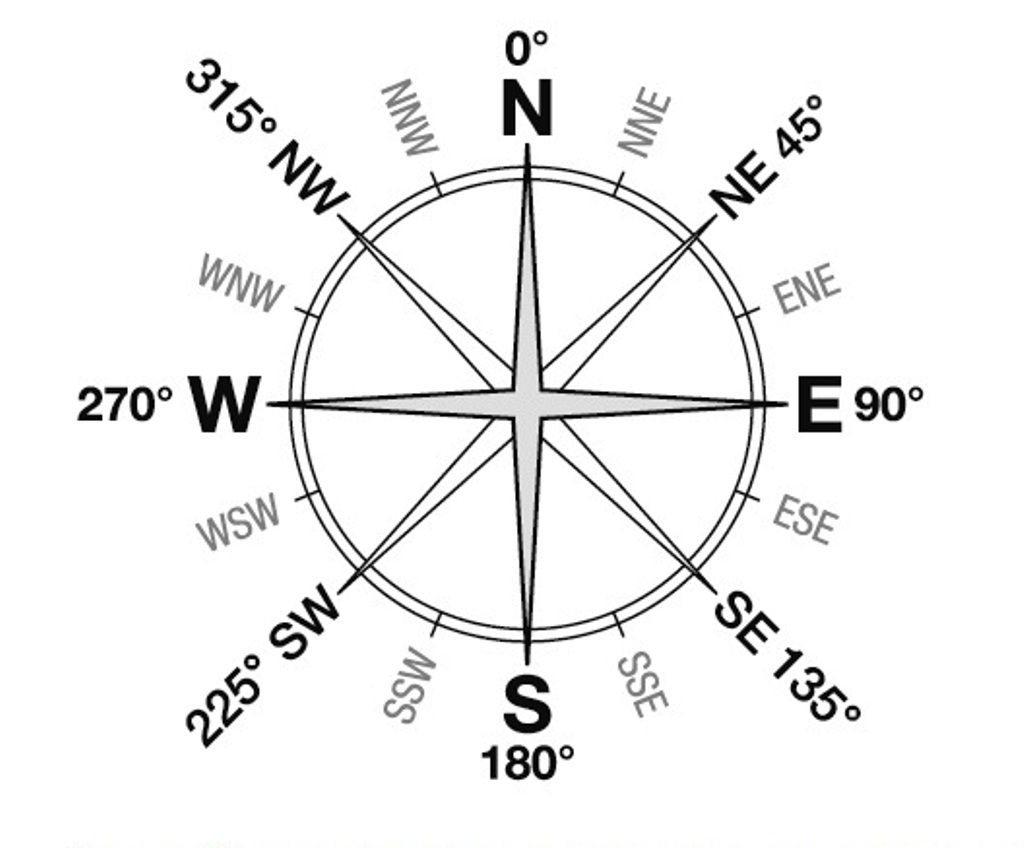
Azimuth is the angle between the direction to north and the direction to the desired object. The compass dial (limb) is divided into 360°, where 0° corresponds to north. Specifying an azimuth, for example 13° or 228°, gives a much more precise direction for travel than the approximate "northeast."
Magnetic Declination and the Two Norths
The Earth's magnetic pole is not stationary—it constantly shifts. Currently, it is located in the region of Northern Canada. For mapmaking, a fixed point is used—the geographic North Pole (true north). As a result, north on a map and north according to a compass (magnetic north) often do not coincide.
The angle between these two directions is called magnetic declination. Its value depends on your location on the planet and changes over time. For accurate navigation, this correction must be taken into account. Quality maps indicate declination. For example, an entry might read: "Magnetic pole as of July 2006 is approximately 3°35′ west. Annual change is about 0.09′ east."
If the map lacks this data, it can be found on specialized online resources. All necessary information, including the latitude and longitude of the hike area, should be researched during the planning stage.
When working with a map and compass, declination is either added to or subtracted from the readings. A simple rule to remember is: east declination is added, west declination is subtracted.
Types of Compasses
For tourism, a liquid-filled compass like the Silva type is optimal. Its needle is suspended in damping fluid, which speeds up its settling. The body of such a compass is fixed, and the rotating dial with a degree scale allows for easy determination and input of azimuth corrections.

Practical Navigation Techniques
Mastering six basic techniques will make you a confident navigator.
Walking on an Azimuth
This is the fundamental skill. If an object is visible, determine its azimuth with the compass and move towards it, constantly checking your direction.
1. Point the compass's orienting arrow at the object.

2. Rotate the dial so that the orienting lines align with the magnetic needle (use the north end of the needle).
3. Note the azimuth value on the scale (do not apply declination correction here, as you are working directly on the ground).

4. Move forward, keeping the needle aligned with the orienting arrow.
Even a small unaccounted-for declination of 3° will lead to a deviation of 50 meters for every kilometer traveled. Also remember that the needle can be deflected by local magnetic anomalies (man-made objects, ore deposits). Regularly recheck your readings.
Orienting the Map
To align the map with the terrain, it must be oriented with magnetic declination in mind.
1. Set the declination correction on the dial (e.g., for west declination of 3°: 360° – 3° = 357°).
2. Place the compass on the map, aligning its orienting lines with the map's meridian lines (the vertical grid lines).

3. Without changing the setting, rotate the map together with the compass until the magnetic needle points to the value set on the dial (e.g., 357°).

4. The map is now oriented, and you can determine directions to objects.
Determining Direction of Travel from the Map
If you need to plot a route from point A to point B on the map:
1. Place the edge of the compass so it connects the start and end points.
2. Rotate the dial so the orienting lines become parallel to the map's meridians.
3. Lift the compass from the map and add the magnetic declination to the obtained value.
4. Holding the compass level, turn your body until the magnetic needle aligns with the orienting arrow. The direction of the travel arrow is your path.
Plotting a Visible Object on the Map (Forward Intersection)
This method allows you to accurately mark an object you see on the map.
1. Choose two known points on the ground from which the object is visible, and mark them on the map.
2. From each point, determine the azimuth to the object, applying the declination correction.
3. From each point on the map, draw a line along the corresponding corrected azimuth. Their intersection indicates the object's location.
4. A third intersection from another position increases accuracy.
Returning Using Back Azimuths
To retrace your steps, use back azimuths.
Having walked, for example, 200 paces on an azimuth of 60°, to return you need to move on an azimuth of 240°.
Calculation rule: if the original azimuth is less than 180°, add 180°; if it is more than 180°, subtract 180°.
Determining Your Location (Resection)
If you have a general idea of your location but need to pinpoint it on the map:
1. Find two landmarks on the ground that you can identify on the map, located at an angle to each other from your position.
2. Determine the azimuth from your location to each landmark, apply the declination correction, and calculate the back azimuth for each.
3. From each landmark on the map, draw a line along its back azimuth. The intersection of the lines indicates your position. A third landmark increases accuracy.
Bypassing Obstacles
Obstacles like ravines, thickets, or lakes are common. If they are not fully visible, it's easy to lose your course while bypassing them. Use the rectangular bypass method:
1. Facing your direction of travel (along your azimuth), turn 90° in a convenient direction to bypass the obstacle (e.g., right).
2. Walk straight, counting paces, until you have cleared the obstacle.
3. Turn 90° in the opposite direction (now left) and walk forward until you are clear of the obstacle's length.
4. Turn 90° again (right) and walk, counting the same number of paces as in step 2.
5. Turn 90° (left) — you will return to your original azimuth.
Training and Preparation
Mastering the use of a compass and map should be done in advance, not in conditions of rain or fog. Purchase a Silva-type compass and a map of your local area for regular practice. This skill is useful both in the city and in any unfamiliar terrain.
If you don't have a compass, a temporary substitute can be made from a sewing needle by magnetizing it against hair or wool and placing it on a light float in water. The needle will indicate the north-south line. To determine north, remember that before noon the sun is in the east, and after noon it is in the west. Remember that such a "compass" loses its magnetization quickly.
Next guide: How to Read a Map Correctly and Plan the Perfect Route Previous guide: Teamwork: How to Make a Hike Successful You can view the full list here: Survival Guides for the Mountains


