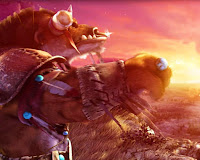
For the most part, Shaal used the traditional blend passed down by his mentor. But from time to time, he allowed himself experiments: the world was changing quickly, and what had once seemed unshakable now easily came into question. So Shaal tried to keep his nose to the wind and use whatever the spirits suggested. A troll acquaintance, Lundu, a shaman of the Darkspear tribe who had been here on a reconnaissance mission, had tipped him off about these mushrooms. Shaal’s supply of ingredients was running low, and while searching for replacements, he’d come across these fungi, which—unlike the Kalimdor variety—had a stronger and somewhat different effect.
The whole day had passed in hunting and gathering. Now it was time to think about a place to spend the night. In his search for mushrooms, he had wandered too far south, into uninhabited territory. An inn or anything of the sort in this godforsaken desert was out of the question. The only Horde camp in these parts, New Kargath, lay far to the west. Still, Shaal was no stranger to sleeping under the open sky.
Turning to the spirits, he asked them to show him a comfortable spot sheltered from the wind. The spirits were benevolent, and soon he found a hollow at the base of one of the rocky hills. Two massive boulders formed a natural shelter, shielding him from the wind on all sides, while the opening offered a clear view of all approaches. After giving thanks to the spirits, Shaal set about making camp: he lit a fire, put water on to heat for an herbal infusion, and spread out his bedroll. Settling onto it, he began his supper of dried meat and dried fruit—his usual trail fare.
While Shaal ate, the last glimmers of sunlight faded, and the desert was wrapped in night. He filled his pipe and lay down so that with half‑open eyes he could see the approach to the camp, but he wasn’t planning to sleep just yet. Using a twig, he nudged a coal from the fire and lit his pipe. Drawing deep, he turned his thoughts to the spirits, attuning himself to any voice they might offer. Slowly exhaling the smoke, he relaxed into a meditative half‑trance. In contested lands, it didn’t do to drift off completely—otherwise you might not come back.
An hour later, images of the night‑time desert began to drift before his inner sight, different from those his eyes actually saw. Spotting the familiar boulders in the distance, Shaal realized: the spirits were showing him what someone else was seeing. Someone was approaching. Soon the clatter of hooves reached him—a lone rider. Understanding that the traveler was heading straight for this spot, Shaal waited calmly. The spirits had only warned him of an approach, not of danger.
In the moonlight, he made out the animal: a mountain ram, the kind dwarves usually rode. The rider stopped at a respectful distance.
“Good evening, honored sir! Would you permit a lone peaceful traveler to share this shelter with you for the night?” the newcomer said, clearing his throat, speaking in Common.
“Why would I not, if the traveler is indeed peaceful?” Shaal replied.
The dwarf rode closer and dismounted. Approaching the fire, he said with surprise, “A tauren? That’s the last thing I expected to meet in these parts. Forgive me if I’m being tactless—we dwarves tend to speak first and think later.”
“No harm done. I’d have been surprised too, if I’d met a tauren here,” Shaal laughed. “Come, sit by the fire. No need to stand in the wind.”
“Aye, the night wind is cold here,” the dwarf agreed. He hobbled his ram and walked over to the fire, carrying a knapsack and a rolled‑up blanket. Spreading his bedroll near the warmth, he sat down with a sigh and began to take out food and a flask.
“What brings you so far from Mulgore, honored sir?” he asked, unwrapping his bundles.
“Oh, I decided to gather some mushrooms. They’re stronger in these parts than the ones back home.”
“Turns out we’re here for the same reason! I came for them too. Without them, my famous tincture—known throughout Ironforge and all the Eastern Kingdoms!—wouldn’t be half as good.”
“You don’t mean ‘Burning Lava’?” Shaal asked, surprised.
“The very same! I don’t know how many generations the recipe has been passed from father to son in our family, but now I’m its chief keeper and brewer,” the dwarf said with a self‑satisfied air.
“You mentioned the Eastern Kingdoms… Even I, from Thunder Bluff, have heard of it. Though I’ve never had the chance to try it.”
“Well, that’s easily fixed!” the dwarf exclaimed, brandishing his flask. “A cold night like this is the perfect time for Burning Lava.”
“Praise the spirits! Truly their ways are mysterious and unfathomable. But I’ve quite forgotten my manners.” Shaal rose. “Allow me to introduce myself. I am Shaal of the Stone Hoof, son of Shulla of the Unshakable Totem, a shaman of Thunder Bluff, as my father was before me.”
“Aye, this cold wind’s addled the last of my wits,” the dwarf said, getting to his feet in turn, and intoned ceremoniously: “I am Gumalth, son of Smarth, of the Bronzebeard clan. I serve as a priest in the Cathedral of Light, and I’m an alchemist to boot.”
“Well, with the formalities done,” Shaal said, sitting back down, “I gladly accept your offer, Honored Gumalth.”
“The honor’s mine,” the dwarf said with a smile, handing him the flask. “And you can just call me Gum. I’m used to it.”
“As you say, Gum,” Shaal answered, taking a swallow from the flask—and nearly choked. Gasping, he said hoarsely, “Truly, ‘Burning Lava’… it went all the way to my hooves.”
“It does that,” the dwarf said with a smug smile, taking a gulp himself. He merely squinted slightly—more in pleasure. Taking another swallow, he grunted and added with a laugh: “It has another property too—loosens the tongue. For us dwarves, that’s no trouble: we speak first and think later anyway. But if someone has something to hide… they’d best beware.”
“Well, that might work in our favor,” Shaal smiled. “I propose a game. We used to play it at the insistence of my first teacher—my grandfather…”
“Not your father?”
“My father was still too young to mentor back then; he served as a battle healer in campaigns. My grandfather dedicated himself fully to teaching the young who’d chosen the path of the spirits. The game was this: in the evenings around the fire, each of us had to tell a story. It didn’t matter what about—so long as it was interesting, or funny, or instructive. The only rule was that no one else present could know the story. If the story was already known, the teller had to undergo a trial of my grandfather’s choosing.”
“Hmm… what was the point?” Gum asked.
“We didn’t understand the point at first either, but in time it became clear. In searching for new stories, we had to talk more, listen more, remember more—it broadened our horizons.”
“Aye, your grandfather must’ve been a wise one.”
“Wise, and a trickster, and very kind,” Shaal said with a wistful smile. “I suspect most of the stories we told, he knew perfectly well—he just never let on. And he knew an endless number. When he told stories himself, we listened breathless.”
“A good thing. For a night like this, honestly, we need to sleep with one eye open anyway. You never know. So your proposal, Honored Shaal, is most welcome.”
“Very well. Since I proposed, I’ll begin. Let’s fill our pipes, and we’ll start. I’ll share my blend—though the mushrooms in it are from Kalimdor.”
“No matter. There’s the local kind in the flask. I’ll be glad to try it,” said the dwarf, deftly packing his pipe from the offered pouch. He lit it from the fire and drew deep. “Hmm… an interesting flavor. Pleasant, and something else… I can’t quite place it.”
“Yes, I often try to improve the blend by adding new ingredients to the traditional one. Sometimes the results are successful.”
Shaal shifted a little to make himself more comfortable, was silent for a moment as he gazed into the fire, and began.
“This story is about a centaur named Zugrath. He was a khan and a shaman of a small tribe that dwelled on the western slopes of the Stonetalon Mountains. It might seem strange that I’m telling a story about centaurs; for long years they were enemies and a terror to us tauren. Aggressive, primitive—they seem more like beasts than thinking beings. But Zugrath was different. He also possessed a very rare gift for a centaur: foresight. Not a very strong gift, I must say, but strong enough for him to understand that the conflict with the tauren could prove fatal for the centaurs.
After his visions, he tried to make the other khans see reason, telling them that a new people would appear on Kalimdor from an unknown world and would unite with the tauren into a new force against the centaurs. No one listened; they thought his talk was nonsense. He spoke at the great gatherings of all centaurs in their Valley of Spears, he traveled to the encampments of individual khans—but nowhere was he taken seriously. Worse, his pleas for reconciliation aroused hatred against him. The fierce centaurs, who lived for fighting and raiding, couldn’t understand what he wanted from them; war and raids were their life.
When he realized he would achieve nothing, he led his tribe far to the north and began to avoid joining raids on tauren settlements—either with his own tribe or alongside others in combined campaigns. They roamed in the northwestern part of the Stonetalons, in the valleys beyond Tal’dar Watchtower, near the border of Ashenvale. There his tribe raised livestock peacefully, thinking nothing of war and strife.
Then one day, the centaurs of several tribes launched a raid on a large tauren settlement in the Stonetalons. As always, showing no mercy, they began to kill everyone, destroying and setting fire to whatever they could reach. Only a small handful—about ten tauren—managed to flee north, in the very direction where Zugrath’s tribe roamed. The centaurs, having completely destroyed the settlement, feasted right in the midst of the ashes.
The fleeing tauren walked all night, utterly exhausted, and to their horror came straight upon Zugrath’s encampment. They had no strength left to run or hide again, and they prepared themselves for the worst. But their astonishment was great when the centaurs not only did not attack them, but helped them—fed them, healed their wounds, and gave them places to rest in tents. They told them not to be afraid; once they had rested, they would speak with the tribe’s khan and then help them reach their own people.
Zugrath had hoped this might be a chance to open some kind of dialogue with the tauren, to show that there were other centaurs.
But it was not to be. Not all the centaurs were feasting—though primitive, they were not entirely without sense. They had posted sentries, who noticed the fleeing tauren’s tracks and sent a tracker after them. Reasoning that the fugitives could not have gone far, they decided they could continue celebrating and deal with them later. The tracker caught up with the tauren and, following unseen, witnessed everything that happened. Once he realized the tauren had been given shelter and were not going anywhere, he raced back.
When the tracker told his tale, the centaurs flew into a rage and surged en masse toward the encampment. No orders from the khans were needed, no commands. For the centaurs, this was betrayal—sacrilege—and every one of them was inflamed with fury. Each wanted to be the first to reach the traitors’ camp to personally punish the turncoats and the surviving tauren.
They fell like an avalanche. Even the sentries could not warn the peacefully sleeping camp. Just like the tauren settlement, the whole encampment was put to the sword and set ablaze. The khans personally hacked Zugrath to pieces, leaving no part whole. The centaurs from the united tribes killed all of Zugrath’s kin and ground the camp to dust; only a scorched patch remained.
And yet, by some miracle, a few of the tauren managed to escape in the general chaos. I suppose it was because they had never thought of fighting back, only of fleeing. From them, the story became known. But given how it ended, even the tauren preferred to forget it, so that there would be no temptation ever again to trust centaurs. As for the centaurs who took part in that attack, they decided not to speak of what had happened at all, so that no memory of the traitors would remain. That is the story.”
“Well,” Gum breathed, taking a swallow from his flask and handing it to Shaal. “A sad and instructive tale. Wasn’t there some centaur who wanted to unite them all?”
“An outcast, yes. But that story happened long before him. Even before the coming of the orcs and the rise of the Horde, which Zugrath had warned about.”
“At least those mad centaurs aren’t kin to you. Which is more than I can say for our dear relatives—the, ahem, Dark Iron dwarves.” Gum cleared his throat. “Well, then, it’s my turn.”
“I’ll listen with interest, Honored Gum,” Shaal said, taking a sip from the flask and, as before, choking slightly. “I just can’t get used to it. Strong enough to burn a hole right through you.”
“That’s why it’s called Burning Lava. It burns but doesn’t consume—it warms and gives strength. That’s its virtue.”
Gum puffed on his pipe, the ember briefly lighting up his thoughtful face, and began.
“Right then, here’s my story… Not far from Kharanos, in the mountains of Dun Morogh, there’s a small tribe of Frostmane trolls. They keep to themselves, and everyone reckons they’re odd. And what’s interesting—even they have outcasts. An old Frostmane troll lives in a little hut apart from his tribe. Now, this troll lived—maybe still lives—alone in that hut, and what he does isn’t quite clear. He either casts spells or something else. He’s always brewing something in a cauldron outside, wandering the hills around the hut, muttering to himself constantly. A right curious fellow.
My father, when he was a lad, and a bunch of his scapegrace friends decided to find out what the troll was really up to. Rumors were flying all over—some strange, some gruesome. One rumor said that at night the troll came down to the dwarves’ or gnomes’ villages to snatch children, then boiled them in his cauldron.
They knew roughly where the hut was, and one day they set off to learn the truth about that strange troll. There were four of them, all young dwarves. They crept up to the hut, where a cauldron was bubbling over a fire outside, but the troll himself was nowhere to be seen. They waited a good long while, but the troll never appeared, so they decided to take a look inside the hut and began to edge toward it.
The hut was a ramshackle affair, cobbled together any old way, with cracks everywhere. Peering through them, they could see there was no one inside either. Mustering their courage, they decided to take a closer look at what was inside, and slipped in through the sackcloth that served as a door. Inside was dim, but everything was easily made out thanks to the chinks in the walls. A bed of rags, a makeshift table made of a door laid across some blocks—clearly not from the hut. The table and every corner were cluttered with odds and ends that could only be called magical ingredients with the greatest stretch of the imagination. Much to the young dwarves’ disappointment, there was nothing else in the hut, and they didn’t fancy rummaging through the junk.
Just as they were about to leave, the sackcloth at the entrance was suddenly flung aside, and the troll lurched into the hut.
‘So, so, who we got ‘ere? Ah… dinner come all by itself,’ the troll muttered, waving a hand negligently at the stunned dwarves. To their horror, they realized the troll could indeed do magic, because a spell instantly paralyzed them. Rubbing his hands and looking at the dwarves, the troll burst into a high, cackling laugh.
‘Now I chop you into little pieces,’ the troll announced, pulling out a huge rusty scimitar—more like a yataghan—from the shabby robe he was wearing.
Brandishing the blade, he moved toward the dwarves—then suddenly froze, staring at them with an empty expression. After a moment’s pause, he dropped the scimitar, rushed to a corner of the hut, and began burrowing through the junk, muttering under his breath in the troll tongue. After a bit of digging, he let out a howl, shook a branch he’d found in the rubbish, and ran out of the hut.
Only now did the young dwarves notice that the paralyzing spell had faded—probably when the troll forgot them and started sifting through his trash—but they were so frightened they hadn’t dared move.
Outside, they could hear the troll’s unintelligible muttering and the sound of bubbling from the cauldron. Then there was a snapping noise, and the muttering stopped. The dwarves stood frozen, scarcely daring to breathe, not knowing what was coming. Hasty footsteps approached, the sackcloth was pushed aside, and a dwarf appeared. He looked at them and said, ‘What’re you frozen for? Get out of the hut—we’ve got half a minute at most…’ and his head disappeared.
My father and his friends didn’t need telling twice. Running out of the hut, they nearly stumbled into a block of ice in which the troll was encased. That dwarf was a hunter and had caught the troll in a freezing trap.
‘Quick, quick!’ the hunter urged them from a small hillock not far from the hut. The young dwarves rushed to him. ‘Get down behind this ridge, just get out of his sight…’
His last words came from behind the ridge, where he and the young dwarves had all gathered.
‘He won’t come after us, will he?’
‘No, once you’re out of sight he forgets you. He’s not right in the head,’ the hunter said with a grin. ‘And what in the blazes possessed you to go into that lunatic’s hut?’
‘Well, we were just… we…’ the rascals mumbled.
‘Right, looking for adventure. If I hadn’t been passing by, who knows what that madman might’ve done to you. Do you even realize that?’
‘We just wanted to have a look.’
‘Hmm… “just wanted to have a look,”’ the hunter shook his head in dismay. ‘Youngsters these days have no sense.’
‘Could you tell us about him?’ my father plucked up the courage to ask. ‘With all the rumors going around, nobody knows the truth. That’s why we wanted to find out for ourselves.’
‘Well, I suppose I’ll have to, to stop you from needing rescuing again,’ the hunter chuckled. ‘But let’s get farther away from him—sometimes he wanders these parts.’
Then the hunter led them along paths only he knew to a small campsite among some low bushes. There was an old fire pit and a little cave where he kept his simple gear: a cooking pot and other supplies.
‘Right, gather some kindling quick, I’ll brew us some herb tea. Then I’ll tell you about that troll.’
The dwarves quickly collected firewood. The hunter lit a fire, set the pot among some stones, and poured in a handful of dried herbs.
‘There we are. Soon it’ll be boiling—we’ll warm up before we head off. So, this troll was once a powerful warlock in his tribe. Seems a demon tempted him, promised all sorts of things if he’d perform a ritual it showed him. I don’t know how they communed. But during the ritual, something went wrong—or maybe everything went exactly as the demon wanted. Either way, the troll’s wits were scrambled. The demon vanished, but this one’s been brewing in his cauldron ever since. His tribesmen put up that shabby hut for him and sometimes give him food, hoping he might come to his senses one day. But I doubt it. He seems to be getting madder by the day.’
‘Why don’t you just kill him?’
‘Well, for one thing, he’s mostly harmless. He wanders around, brews his concoctions, and if you don’t bother him—like some idiots do—he doesn’t cause any harm. For another, Frostmane trolls are mean and vengeful. I hunt practically on their land, and as long as I don’t show myself, they turn a blind eye. If I killed one of their tribe, even a mad one, they’d hunt me down deliberately. I’d never hunt here again.’
‘What’s so special about this place?’
‘The trolls themselves don’t hunt much here, and other hunters stay away because of them. So I can’t risk stirring them up, or I’d lose pristine hunting grounds. And you lads need to get out of here as fast as you can. I’ve learned to blend in, but strangers they’ll sniff out quick—especially witless whelps like you. And I hope you’ll forget the way here—at least until you’re grown and strong.’
‘So you wouldn’t mind if we came to hunt here someday?’
‘Are you daft? You think I’m an enemy to my own people and a friend to trolls? Well, I never… All right, finish your tea, we’re moving out. I’ll lead you so you don’t stumble into any more trouble, hunters…’
After that, he escorted them to the inn in Kharanos—where, as it turned out, he was headed himself. So that’s the story.”
“Ha ha ha! A funny tale!” Shaal laughed. “If that hunter hadn’t appeared, though, it could have been a sad one. Still, it’s a fine story. I think Grandfather would have been pleased with us tonight.”
“And when he wasn’t pleased—what sort of trials did he give?”
“Nothing too harsh—just uncomfortable. For example, when everyone was bedding down, you’d have to sing a lullaby for the whole camp. Or stay awake all night tending the fire. If there was a mountain nearby, you’d have to climb to the top and come back down while the others rested. And the next day, you’d get no special treatment.”
“I can see why you’d want to avoid those.”
“Yes. But since we succeeded, we’d best get some sleep…”
“Good idea. My ram will warn us if anyone approaches. He’s sensitive.”
“Excellent. Then we can rest.”
Shaal threw a few more dry twigs onto the fire and settled in. Gum took another swig from his flask, stowed it in his knapsack, and stretched out on his blanket. Silence descended on the campsite, broken only by the occasional crackle of the fire and the dwarf’s soft snoring. Shaal half‑closed his eyes, slipping as was his habit into a half‑trance, not allowing himself to fall completely asleep. That kind of rest was enough for him.
With the first rays of the sun, the wind died down. While they breakfasted and packed up, no trace remained of the night’s chill. The rising sun rapidly heated the desert. By the time they were ready to go their separate ways, the air was already shimmering with searing heat.
They rode together as far as the turnoff to Fizzle’s camp, where they parted.
“It was a pleasure to meet you, Honored Gum. I hope we meet again,” Shaal said in farewell.
“I hope so too. We passed a good time last night with those stories. Safe travels to you, Honored Shaal!”
“And may your road be light!”
Shaal raised a hand in farewell and began climbing the rocky slope that led to the settlement. The dwarf waved back and set off toward Ironforge.


