I set off on my solo hike more out of curiosity. The cliché "testing yourself" doesn't quite fit here either. I chose a route through a very familiar gorge. It starts right by the road, just fifteen miles from the city. The area is inhabited: a village near the road at the start, and all along the gorge you come across farms, vegetable gardens, and seasonal shepherds' huts. You often see locals, but the further you go, the fewer there are, of course. I'd been in the mountains alone many times before, but never far, and never with an overnight stay — just day hikes. I'd done overnights too, but always with someone: a group, or at least one or two others. But to be alone and spend the night — that had never happened.
So I planned this hike: a familiar, relatively safe place, but still away from people and civilization. The main goal was to spend a night alone in the mountains. While I was getting ready and walking to my first campsite, I kept thinking about one thing. Objectively, there seemed to be no danger: close to the city, no people around, the wildlife is skittish and avoids humans anyway. But subjectively, it felt unsettling, being the first time and all. There's this irrational fear, and no matter how hard you try to think rationally, something keeps chipping away at your confidence, and all sorts of dark thoughts creep in.
But I won't get ahead of myself; I'll tell it all in order. I planned for two days and one night, but it turned out I hiked for three days and spent two nights. I'd packed extra food, so it actually worked out better. On the morning of the first day, I got dressed unhurriedly and packed my backpack for good. Right away, I found the first plus of solo hiking: no need to constantly watch the clock, afraid of being late or arriving too early. Calmly, without any fuss, I got ready, took a shuttle to the village, walked through it, and began my path along the Odzhuk Gorge.
The route I took has its own history. It's an old, long-forgotten tourist trail called "The Odzhuk Ring." The word "ring" in the name means that if you follow it, you'll return to where you started. It goes like this: you walk the entire gorge to a pass and reach a plateau; after a couple of miles across the plateau, you come to another pass; you descend that pass into a small gorge with a tributary of the Obi-Dzhuk river, and follow it back out into the Odzhuk Gorge. Soviet tourists laid it out back in the 60s and 70s.
About six miles closer to the city, on the highway, there used to be a tourist base, "Varzob," which back then was considered of national significance. That's where guides and instructors would lead tourists from all over the Soviet Union on this and many other routes — right up until the Union collapsed. The current renaissance of tourism hasn't touched these parts. Now only locals use the trails around here, and the old routes are used for herding livestock. Of course, they always herded livestock there, but before, you could also meet tourists.
The Odzhuk Gorge itself is about fifteen miles long. It probably took its name from the local river, the Obi-Dzhuk. The trail follows this river and, because of the terrain, constantly crosses from one bank to the other. This gives the gorge another name: "The Gorge of Seven Bridges." But that doesn't quite make sense to me. First, they're more like little footbridges than actual "bridges." Second, there are ten of them, as I saw for myself. Although, maybe there really were seven once.
The spot I was roughly planning to stop for the night is at an altitude of about 7,500-7,900 feet. The trail to this spot climbs gently through the gorge without any sharp changes in elevation. You just walk along the river and during the day you notice subtle changes around you related to the ascent. If at the start of the gorge the trees and bushes are the same as in the city, then above 5,000 feet you begin to see juniper, birch, and walnut trees.
Walnuts are interesting. They usually grow along the river and seem unowned, but it turns out they're not. If you just walk along and pick up fallen nuts as you go, no one says anything. But if you start knocking them down and gathering the crop, the tree's owner might show up. Like they're lying in ambush or something. I was passing through a walnut grove where I decided to rest and gather some nuts. I was about to leave when I saw some guy approaching. The grove wasn't on the trail, so he was clearly coming towards me. But he didn't say anything about the nuts — he could see I wasn't there to harvest them commercially, just a tourist.
We chatted a bit and walked on together. He said his cow was taking a long time to come back, and he needed to check. He walked with me for about a mile, then, following tracks, turned into a small side gorge: "She went that way." Just before meeting him, I'd passed a place where a fresh, torn-apart cow carcass was lying. I asked him about it. "No, not mine," he said. "Died of disease." "Why is it torn apart then?" "Wolves or a bear came at night." And he added that if you leave a cow out overnight, they might get it too. Not necessarily, but quite possibly. Just in case, I asked, "Do they ever attack people?" "No," he says, "as soon as they smell a human, they leave right away."
After saying goodbye, I walked on, often passing through more walnut groves. In the end, I gathered two full bags of nuts. Deep in the gorge, I reached the spot where the tenth bridge should have been. But it was gone — replaced by a felled log. A couple of months earlier, there had been heavy rains and a mudslide — all the bridges were washed away. On my way back, I saw them repairing the eighth one, but it would be a while before they got to the tenth. Still, the place was worth photographing: all that remained of the bridge were the supports on the banks. I'd never been this far before — the gorge is long, and you can only reach these parts if you're doing an overnight hike.
So I'm standing there, photographing this destroyed bridge, when another local comes up behind me without a sound. Even startled me a bit. I look and realize: he's wearing galoshes, that's why I didn't hear him. He wasn't sneaking up; he was just walking along the trail where I was standing. That thing about footwear, by the way, is curious. I remember how carefully I chose my own hiking boots, and everyone I know who hikes even a little is concerned about it. But for locals, it's not an issue. Whoever you meet, they're wearing whatever: slippers, galoshes, rubber boots. You rarely even see sneakers, let alone hiking boots.
Besides the galoshes, this guy was unusual because on his back he had a box instead of a backpack. An ordinary box made of fiberboard, with slats along the edges, like a big parcel box. Tied with thick rope, which also served as straps. I didn't show any surprise — who knows, maybe he just likes that kind of "backpack." But there was something vaguely familiar about the box. Then I noticed he was holding a smoker, the kind beekeepers use. It dawned on me: he's a wild honey harvester, that's why he carries a box — to put the honeycombs in. I asked, and he confirmed it.
I also asked him about the trail, since I was in unfamiliar territory. I had a general idea, of course — I'd studied everything thoroughly on maps. But asking doesn't hurt, and it turned out to be a great idea. If I hadn't asked, I would have gone the wrong way — or rather, not turned, but kept going straight. I would have realized my mistake eventually and had to backtrack to the bridge. And it would have been almost evening by then — I still had to set up camp, gather firewood, cook dinner. So meeting this honey hunter was very timely.
We walked on together for another two or three miles to his camp, chatting along the way. He lives in the village, and they have a plot here in the gorge. The local authorities allocate plots, sort of like leasing them out. They gather berries, nuts, apples, honey (as it turned out), and much more from their plot. Some for themselves, some to sell. That's the kind of setup they have, adapted to local conditions. Along the way, we met another guy with two donkeys, his brother. He was coming from the village leading the donkeys — probably to fetch something. I didn't ask; I was more interested in the local trails, because maps are one thing, but reality looks different, and it's easy to get lost.
The guys offered to let me stay at their camp; we had just reached it. But there were still a couple of miles to the end of the gorge, so I declined — or rather, I used that as an excuse. Otherwise, the whole point of the solo hike would be lost. Getting closer to the pass would be good, though, so I could wake up and climb it right away in the morning, instead of hiking those miles first. Whatever you can do today, do it today — that's how I see it.
When I started to decline, the guys began to scare me: "It's dangerous alone in the mountains, there are bears. See those tracks? And those broken bushes? That's him — the bear. There are wolves too, and lots of other things. But with us it's safe, we'll have dinner, sit around, talk." They really seemed to want me to stay. People in the mountains are generally very hospitable. I listened, thanked them again for their hospitality, but politely and firmly refused, and continued on my way down the gorge. You can't explain your motives to every person you meet. I walked on, thinking: I'm already on edge, and now they're making it worse.
But you know, I think fear is a good thing. It mobilizes you, acts as an alarm system. In ordinary life, in a comfortable and familiar environment, your consciousness kind of falls asleep, and you do many things on autopilot. This sleep can last a lifetime if you don't shake yourself up now and then by leaving your comfort zone. And in that case, fear shows you where to go — the direction where you can meet it face to face, overcome it, and ultimately become stronger. Treasure is always hidden in the darkest corners, and the deeper you dig, the more you find.
After covering the last couple of miles, I started looking for a campsite. I found one quickly. It must have been someone else's old spot — maybe even those guys', from last year. Right by a juniper grove: a small clearing, a leveled spot for a tent, several fire rings, some wood. I quickly set up the tent and, while it was still light, gathered more firewood. I finished in the dark. I lit a fire and started making dinner. By the firelight, I changed clothes, laid everything out, and, in a pretty good mood because everything had worked out, sat down to eat.
I'd gathered a lot of wood, so I made a big fire. I was in high spirits, and the bustle had distracted me from my worries. But deep down, those cowardly thoughts were still flickering. They'd break through the good mood, but as I sat there, I calmed down, relaxed, and tried to get them under control. It turned out to be simple. I looked around and thought, "Is there any danger here and now? No. Is anyone or anything attacking? No." I just acknowledged that state and tried to stay in it, without thinking. What you consciously focus on tends to expand.
After dinner, I just sat and watched the fire. A wave of peace washed over me. Silence, just the crackling of the fire and the muffled murmur of the river below, which here was more like a stream. The moon hadn't risen yet, but it wasn't dark: the entire sky was strewn with improbably large, shining stars. A light breeze brought the intoxicating mountain air, scented with juniper and grass. My consciousness, being here and now, absorbing all this magnificence, expanded to fill the entire visible space. This could hardly have happened if I'd been with someone. My attention would have been on my companions, and the surroundings would have been just a backdrop, not a part of me as they were now.
A joyful thought flashed: if I hadn't been persistent, or if I'd stayed with the guys at their camp, my cowardice could have cost me all this magic. But it was just a flash, not starting the usual internal monologue. In the mountains, with less oxygen, a meditative state comes naturally, without forcing, especially if you're used to it. Because of this, the evening stretched on. I didn't want to move or do anything; the day's hike was catching up with me. So I just sat and enjoyed the evening, occasionally throwing wood on the fire.
After a couple of hours, the wind picked up — it's autumn, after all — and I started getting ready for bed. I gathered my remaining things, put them in the tent, and placed a thick log on the fire so it would smolder until morning. It's good not to be afraid, but it's also foolish to be reckless. A fire will keep uninvited guests — meaning animals — away in any case. I crawled into the tent, got into my sleeping bag, and slept like a baby. I only woke once during the night. I woke up because it seemed to be getting lighter. I checked my watch — two in the morning. Definitely not dawn. I crawled out of the tent — the moon had risen. Full moon, bright as day.
In the morning, I woke with an extraordinary sense of elation, a feeling of having somehow overcome myself. Maybe I'll never have another night like this, alone in the mountains. Or maybe I'll have hundreds. But this night will always be special. Despite the fears and doubts, I made a conscious decision and carried it out, overcoming another psychological barrier. Overcoming is about breaking down those invisible barriers that separate us from ourselves and disconnect us from the world around us.
While I was having breakfast, I heard some shouting — the way locals call out to each other when they're at a distance. At first, I didn't pay attention; it came from somewhere far away, but gradually the shouts got closer. I wondered, what are they doing, walking around and yelling? But it turned out to be simpler: they were herding livestock — sheep and goats. First, some very serious-looking dogs ran past me with a preoccupied air. They looked me over carefully and ran on. The herd followed. Then the shepherds came. Two just said hello and passed by, but one, who seemed to be the senior, stopped, and we talked a bit. They had just come from the pass I was planning to climb.
I broke camp and set off. Right from my campsite, the climb to the pass began. Gentle at first, then steeper and steeper. It took another couple of miles to reach the saddle — a good workout first thing in the morning. Honestly, the climb wasn't easy for me. I don't know if it was yesterday's hike, the altitude beginning to affect me, or most likely a combination of both, but I struggled. However, after a couple of hours, the ordeal was over, and I reached the pass. From the pass, instead of following the trail straight, I turned left towards the edge of the plateau to take some photos.
This decision significantly lengthened my time on the trail. I took a detour, but that wasn't the only issue. The edge of the plateau turned out to be like a roller coaster: I walked up and down, up and down. By the time I reached the next pass, I simply had no strength left to climb it. A long, steady ascent led to the pass. The interesting thing about this pass is that the route goes over the summit, with cliffs dropping into the gorge on either side. I didn't know that at the time, so I decided not to climb, but to go around it, and also to look for a campsite. It was becoming clear that another night in the mountains awaited me.
After going around the mountain with the pass, I saw another gorge on the other side, but I still didn't go up to the pass. I'd run out of water, and there wouldn't be any on or beyond the pass — my only option was to descend into the gorge, where I could see a spring below. This was quite an adventure. It took me two or three hours to descend to the water. Then, by the time I'd drunk my fill, refilled my bottles, and climbed the other side of the gorge, the sun had already set. That wasn't a problem; I decided to stop for the night right on the ridge that ran from the mountain with the pass. Up top, in the twilight and then by starlight, everything was perfectly visible, and I built a fire. I didn't bother cooking dinner — just had tea and nuts.
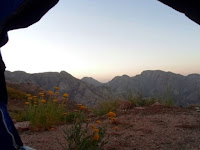
This second night brought no doubts or fear. It felt as natural as if I hadn't been alone. I confirmed to myself once more: the Rubicon is crossed, as they say. While I was busy setting up the tent and heating water for tea, I didn't pay much attention to my surroundings. But finally I sat down, cracked plenty of nuts, brewed tea, and began to survey the landscape. It was incredibly beautiful. Now I was higher, and the stars seemed even more numerous. Mountains stretched in every direction, clearly visible in the soft light. "High I sit, far I see," as the saying goes. The wind was stronger here, blowing steadily, and I could hear the tent flapping — it added to the atmosphere.
In the mountains, truly, every evening is special in its own way. And it doesn't matter if you're alone or with companions. Hiking with friends has its own big pluses: sitting by the fire like this, the conversations, the hiking tales, stories from the experienced ones. And all that intimacy against a backdrop of huge stars, the crackling fire, muffled sounds. You wish the evening would never end. That kind of connection with nature can't be replaced by any substitute, like watching TV or surfing the web. But this evening, I didn't stay up late — the fatigue was catching up with me. I put my things away and crawled into the tent to sleep.
I woke up before sunrise. Another wonderful morning. I crawled out of the tent and just sat for half an hour, looking around. It's hard to describe the state: a kind of serene clarity, without thoughts, without judgments. I could have just sat there forever. But then my mind woke up: "Hey, we haven't been to the pass yet..." — and broke the spell of the morning. I packed all my things into the tent and, without breakfast, headed for the pass while it was still cool. I climbed up, looked around, took pictures of the pass, the summit, and the surroundings. Descending back, I packed up the tent, stowed my gear, and set off down the well-trodden path.
The descent from the pass took four hours. Finally, following the side gorge, I reached the river that flows through the Odzhuk Gorge. Now I could say with certainty: the Odzhuk Ring was complete. And the hike itself had gone wonderfully; everything I'd planned was accomplished. All that remained was to walk back down this gorge to the road leading to the city.
P.S. This story is based on a real hiking experience and photo review: "Hiking the Odzhuk Circuit"


