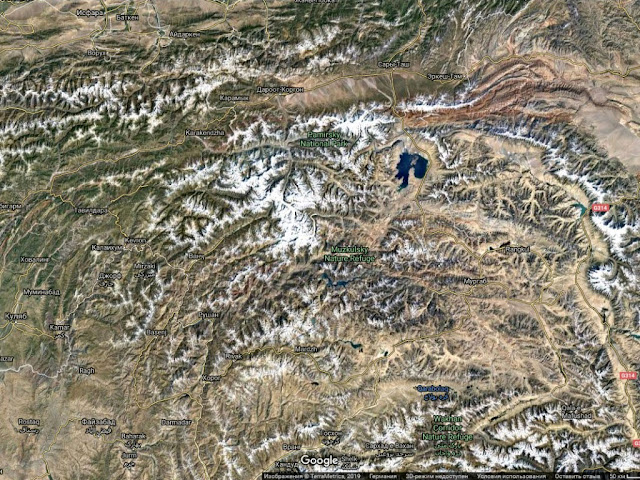
The name "Pamir" has been known to the world since ancient times, but as is often the case with toponyms, its precise meaning remains a subject of debate among linguists and historians. Several versions exist, each intriguing in its own way.
Linguistic Versions: From the "Roof of the World" to the "Foot of the Sun"
The most poetic and popular interpretation is the "Roof of the World." As early as the 16th century, the historian Mirza Haidar mentioned the name "Pamir" or "Bamir" in his work written in Persian. Iranian scholars suggest it might derive from "Bam iar," meaning "Roof of the Earth," which closely resonates with the modern Tajik "Bomi Dunyo" (Roof of the World). Other translations from Persian exist, such as "Po i mor" ("Foot of Death") or "Po i murg" ("Bird's Foot"), though these seem less convincing.
A more meaningful version connects to ancient beliefs. In Afghanistan, the region's name is sometimes still written as "Pai mihr." Mihr (or Mithra) was the name of the sun god in ancient Iranian mythology. Thus, "Pai mihr" could mean "Foot of the Sun" or "Foot of Mithra." For the ancient Iranians, the Pamir was the land to the east, where the sun rose, making this etymology very logical.
Eyewitness Accounts Through the Centuries
The first recorded mention of these mountains comes from the Chinese envoy Zhang Qian, who visited the region around 140–135 BC. He named the Pamir "Congling" — the "Onion Mountains" — due to the abundance of wild mountain onions (anzur). Notably, Zhang Qian mistakenly believed these mountains were an extension of the Tien Shan.
In the 7th century AD, the famous Chinese Buddhist monk and traveler Xuanzang, crossing the Pamir en route to the sources of the Amu Darya, left this description: "Between two snowy mountain ranges stretches a country called 'Po mi lo' (or 'Pa mi yai' — the difference arises from the specific rendering of hieroglyphs), where cold and winds reign, snow falls winter and summer, the soil is impregnated with salt and covered with stones." Considering that the Chinese language lacks the sound 'r', it is plausible that the hieroglyphs were recording the name "Pamir."
In the 13th century, the Venetian merchant Marco Polo, in his "Book of the Marvels of the World," referred to these lands as "Pamer" or "Pamier." In 9th–10th century Arabic geographical writings, the variants "Famir" and "Bamir" appear. Researchers believe the Arabs may have adopted this name from Indian sources.
The Sacred Mount Meru and the Mystery of "mr"
Here we enter a realm where history intertwines with mythology. In Indian mythology, Mount Meru plays a key role — the legendary center of the universe, the axis of the world. It is possible that the name "Pamir" is connected to the Sanskrit expression "upa Meru," meaning "lying under (or near) Meru." This could have evolved into "u pa mer u," which later transformed into the "Famir" and "Bamir" found in Arabic sources.
The root base "mr" (Meru) can be traced in many languages. It is found in the Russian word "mir" (world/peace) and the Greek "pyramis" (pyramid). The Greek word, in turn, originates from Egyptian, where in hieroglyphic writing (without vowels), the base for the word "pyramid" appears as "mr." Some researchers (mostly proponents of alternative history) add a prefix to this, yielding pa-mr — "Pamir," seeing in this a common ancient root connected to mountain worship and the sacred center of the world.
Philosophical Hypotheses and Geological Theories
The idea of a connection between the Pamir and the mythical Mount Meru, as well as the ancestral homeland of humanity, was developed by many thinkers. For instance, the Russian cosmist philosopher N.F. Fyodorov (1828–1903), in his "Philosophy of the Common Task," proposed a bold concept. He distinguished between the material and spiritual centers of ancient civilization. The material center, the "axis of the world," in his view, was the legendary Hyperborea and Mount Meru located beyond the polar circle. However, he placed the spiritual center — the resting place of the biblical forefathers (up to Adam himself) — specifically in the Pamir.
Can a connection between these images be found? Some researchers, such as Russian geologists and planetologists E.P. Kotchemasov and V.I. Syvorotkin, attempt to explain this through the hypothesis of polar shift (true polar wander). According to their non-mainstream theory, tens of thousands of years ago, the Earth's axis was oriented differently, and the poles of cold were located elsewhere. They have suggested that before the last catastrophe (around 10–12 thousand years BC, which some associate with the Great Flood), the Earth's axis ran along the line connecting the Pamir and Easter Island.
The Legend as a Conclusion
If we accept this hypothesis (acknowledging it lies on the border of science and esotericism), the images gain depth: the legendary polar Mount Meru, frozen under ice after the axis shift, survived only in legends and traditions, while its architectural symbols became the pyramids found worldwide. The Pamir, preserving the ancient root "mr" in its name, appears in this worldview as a kind of sacred, spiritual place — a southern outpost of that ancient reality, still guarding its secrets.
Of course, these reflections belong more to the realm of myths and bold conjectures than to rigorous science. However, as a composite image, as an attempt to connect the disparate facts and legends of different peoples, this version has a right to exist. In this article, I simply share a collection of these fascinating facts and hypotheses, leaving the reader free to choose what resonates more: strict linguistics or captivating mythology.