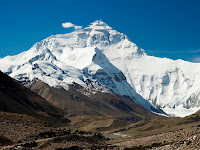
It must be nice to be the boss and find yourself in the right place at the right time. It’s rather symbolic that the planet’s highest point carries the name of such a lucky schemer... In 1852, the British confirmed that this 8,848-metre peak was the world’s tallest. Back then, it was officially listed as “Peak XV,” only later to be renamed Everest.
Of course, a place this outstanding (in the most literal sense) had other names, too. In Tibet, it is called Chomolungma — “Goddess Mother of the World.” In neighbouring Nepal, it is known as Sagarmatha — “Lord of the Sky.” There is also the poetic Chomo-Kankar, “Queen of Snowy Whiteness.” I imagine this mountain has collected countless names, like any truly significant place, but the most common remain Everest and Chomolungma.

Whatever name you choose, people first set foot on its summit on 29 May 1953. Those people were Edmund Hillary and Tenzing Norgay. The two of them were alone only for the final stage. In reality, it was a huge expedition — around four hundred people, a good number of whom were porters from the Sherpa people. The expedition was organised by the Royal Geographical Society and the Himalayan Committee of the Alpine Club. It was led by Colonel John Hunt.
Hunt wasn’t the most famous climber, but he was a brilliant organiser and a subtle psychologist who understood how people behave under extreme stress. He immediately spotted a strong pairing — Hillary and Tenzing. At first, Hillary wanted to rope up with his friend George Lowe, but Hunt insisted he partner with the experienced Sherpa. That decision may well have been the key to their success. After all, another team had set out a day earlier: Charles Evans and Tom Bourdillon. They were meant to reach the main summit via the South Col, but their attempt fell short.
Evans and Bourdillon managed to reach the South Summit (8,765 metres). But it was already too late to push for the top, and on top of that, Evans’s oxygen set failed. Bourdillon insisted they press on — the summit was so close! Yet Evans, as the senior climber, made the hard call: they would turn back. That decision most likely saved their lives. On the descent they staggered with exhaustion, fell repeatedly, and at one point slipped and tumbled down the slope. Bourdillon miraculously stopped their fall with his ice axe.
Hillary and Tenzing, along with George Lowe and the Sherpa Ang Nima, climbed to 8,494 metres and pitched a tent. Then Lowe and Ang Nima descended, leaving the two climbers alone. They woke early on 29 May, had breakfast, and by 6:30 a.m. began their assault. The weather was on their side: clear skies, a light breeze, and a biting -25 °C. By nine o’clock they had reached the South Summit. The final three hundred metres became a real ordeal, especially the sheer ice wall with a treacherous cornice, which they scaled only with immense effort.

At last, at 11:30 a.m., they stood on the highest point of the planet. They hugged, shook hands, and in a burst of emotion started slapping each other on the back. They spent just fifteen minutes on the summit. They took a few photographs and planted the flags of Britain, Nepal, and the United Nations in the snow. Hillary, fulfilling a request from Hunt, left a crucifix. Tenzing, following Buddhist tradition, left biscuits and sweets. Only then did they begin their descent.
When later asked who had stepped onto Everest first, Tenzing replied with a wisdom worthy of the mountain: “I will answer not for my own sake, nor for Hillary’s, but for Everest and for future generations. A little way below the summit, Hillary and I stopped. We looked up, then went on. A rope about ten metres long joined us, but I kept most of it coiled in my hand, so we were never more than two metres apart. I wasn’t thinking about ‘first’ or ‘second’ — in a roped pair, that’s absurd… We moved slowly, but steadily. And then we reached the top. Hillary stepped onto it first, and I followed. If it is a disgrace for me to be a step behind Hillary, then I will live with that disgrace. But I myself do not consider it a disgrace.”
Tenzing Norgay, nicknamed the “Tiger of the Snows,” became a national hero of two countries — India and Nepal. He was born in Nepal but lived in India, and considered himself a son of both lands. For the ascent of Everest, he was awarded the Nepal Star and Britain’s George Medal. Heads of state and kings honoured him, while ordinary people composed songs and legends about him. Yet he remained a modest and generous man.
The New Zealander Edmund Hillary became the most famous mountaineer in the world after the climb. Queen Elizabeth II knighted him, granting him the title “Sir.” Of himself and his achievement, he spoke with remarkable restraint: “I was just a climber of modest ability, an enthusiastic adventurer looking for challenges. We didn’t know whether it was even possible for a human being to reach the summit of Everest. Even the oxygen masks gave us no confidence.”

That is what those modest men looked like — the men who conquered the “Third Pole” of the planet and became legends of mountaineering.


