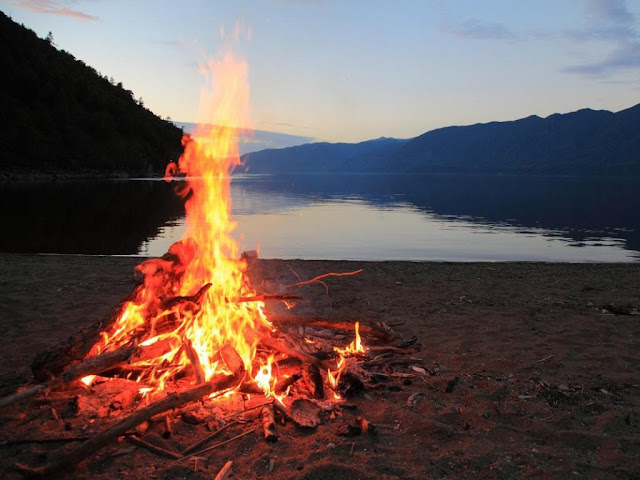
Before you start, remember three main rules:
1. Build a fire only in permitted and specially designated areas.
2. A small fire is better than a large one. It provides enough warmth, is easier to control, and is safer. Remember: you are on a hike, not at a picnic.
3. Preparation decides everything. Haste is the main enemy of a good fire. Take the time to organize things, and the fire will burn long and steadily.
The principle of combustion: the “fire triangle”
To understand how to build a fire, you need to know why it burns at all. The answer is given by a simple model — the “fire triangle.” Fire requires three components:
• Fuel (firewood, twigs).
• Heat (an ignition source).
• Oxygen.
The absence of any of these elements extinguishes the flame. Heat turns solid fuel into combustible gas, which, when mixed with oxygen, produces fire. That is why a small match lights dry grass but will not ignite a thick log — it lacks thermal energy.
Conclusion: Start with small fuel (tinder), and only when it catches fire should you gradually add larger firewood, ensuring air access.
Choosing and preparing the site
The ideal place for a campfire should be:
• Safe: Away from low-hanging branches, dry grass, and tents. Use natural windbreaks (rocks, large stones).
• Convenient: Not far from a source of firewood, but on a spot cleared of combustible debris.
• Dry: On damp soil, build a “platform” of damp or green branches for insulation. In strong wind, you can dig a shallow depression.
Important: Always remove flammable debris around the fire and never leave a fire unattended.
Fuel: from tinder to logs
Success depends on properly preparing the “fuel hierarchy.”
1. Tinder: Materials that ignite from a single match. Ideal choices include:
• Dry grass, birch bark, pine cones, plant fluff.
• Pine resin — the best natural helper. Look for it on damaged trunks or inside knots on fallen pines.
• Alternative: cardboard, paper, dry shavings whittled with a knife from a thick branch.
• Prohibited: Using gasoline, kerosene, and other flammable liquids — this is deadly dangerous!
2. Kindling: Dry branches about the thickness of a pencil (30–40 cm). It is better to take those still hanging on trees — they are drier than fallen ones. A simple dryness test: a dry branch snaps with a crack, while a damp one bends.
3. Main firewood: Prepare it in advance in sufficient quantity. Experience shows: whatever amount of firewood seems sufficient, multiply it by three. Split logs into pieces of different thickness so you can gradually increase the “caliber” of fuel in the fire.
Campfire layouts: three proven methods
All types of campfires are built around the “triangle” principle.
1. Pyramid (Teepee): A classic for quickly producing a tall flame. Place tinder in the center, cover it with a “teepee” of twigs around it, leaving gaps for air. As it catches, add thicker firewood while maintaining the shape.

2. Star: An economical option for cooking. Lay 4–5 thick logs in a “star” shape, with their ends meeting in the center. Only the converging ends burn. As they burn down, the logs are pushed toward the center. This fire gives little heat but a lot of glowing embers.

3. Well (Log Cabin): Gives an even, calm flame, ideal for a cauldron or pot. Two thick logs are laid parallel as a base. Tinder is placed on them, and another pair of logs is laid crosswise on top, forming a “well.” The structure can be built up.

How to light it and help yourself
• Stand so that your body protects the tinder from the wind.
• Light it from below so the fire rises upward according to the principle of natural draft.
• Use a lighter or dry matches (pre-dipped in wax, they will not get wet).
• On a sunny day, a magnifying glass or even the convex bottom of a glass bottle will help.
The main finale: how to properly put out a campfire
When leaving the campsite, you are obliged to completely eliminate the fire.
• Water is the best method. Pour water generously over the fire pit and all the coals, stirring several times with a stick. Do not skimp on water.
• Check it. Hold your hand over the fire site (without touching the coals!). It should feel only moisture and cold. If you feel warmth, keep extinguishing.
• If water is unavailable, cover the fire pit with a thick layer of earth, sand, or stones, completely blocking oxygen access.
• Take special care in coniferous forests and peat bogs, where fire can go underground and smolder for weeks.
Remember: the safety of the forest and people depends on your responsibility. A true camper leaves behind only an extinguished fire pit and a good mood.
Next guide: Life hack: How to Quickly Start a Fire on a Hike Without Firestarter Previous guide: Camping Light from a Phone and a Water Bottle You can view the full list here: Camping Life: Tips, Guides, Lifehacks


