By the way, besides this stone, there are other interesting places on Iskanderkul:
• The waterfall on the Iskandarya River – they also call it the «Fan Niagara»..
• «Snake Lake».
• The cave «Bucephalus's Stall».
• «Viewpoint» Pass.
• And many others. I've only listed the most famous ones. You can see the full photo report of my trip at this link: Iskanderkul Lake.
And here's another thing: the stone itself lies just a stone's throw from yet another remarkable spot – the Iskanderkul Complex Station. This was the first high-altitude station in Central Asia, built to study the climate and monitor mountain rivers. A historic place, too, you could say. But the 'House Book' stone – it's special.
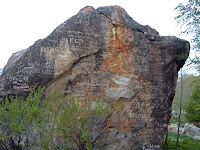
Here it is, The «House Book» Stone – in all its glory.

The oldest inscription on it is considered to be a short one: «РУСКIE 1870 VI». It was left by members of an expedition led by General Abramov in 1870. The expedition was a big one – serious researchers and scientists were part of it: ethnographers, biologists, geologists. Who exactly carved this inscription is unknown. By the rules of the old Russian orthography it should have been «РУССКIЕ», but the stone clearly says «РУСКIE». The person who wrote it was probably a bit lazy to carve an extra «C», or maybe he wasn't very literate.
Here it is:

And here's the spot on the stone where this inscription is located:

For a better picture – a few shots of the «House Book» stone from different angles. When I was arranging the photos, I thought: you might think they show different boulders. But no – it's one and the same stone. Such a diverse stone this «House Book» on the shore of Iskanderkul:


