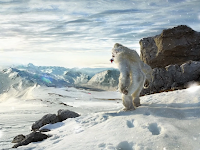
The first scattered reports of encounters with a wild, hairy creature in these parts appeared as early as the 20th century. Witnesses described it as a massive being covered in thick white or brown fur, with powerful legs and inhuman strength. Local residents, who had never heard of the Western terms "Bigfoot" or "Yeti," have long called it Ghul (in the mountainous areas) or Odami-Yavoi ("wild man").
Encounters near Peak Somoni and Expeditions of Enthusiasts
The most famous cases that have come down to us are linked to mountaineers. In 1983, a group of Czechoslovak athletes was climbing Peak Kommunizma (now Peak Ismoili Somoni). Throughout the night before the assault, they felt an intense gaze upon them. According to their account, a huge white creature watched the camp from a safe distance, and at dawn it vanished without a trace into the rocks. A similar incident occurred with another Czech group in 1990 – that time, the Ghul ran past them just a few meters away, giving them a clear view.
But foreigners aren't the only ones lucky enough to have encounters. In 1974, a team of climbers led by instructor Igor Tatsl set up camp in the valley of the Siama River. In the morning, they discovered that their campsite had been visited by a "thief." Huge bare footprints in the snow, ransacked backpacks, and gnawed cans of stew – the vandal was clearly not a bear. The most astonishing part: none of the sleeping climbers woke up from the commotion. Tatsl, thoroughly intrigued, dedicated several years of his life to searching for the "Odami-Yavoi" in that area, organizing expeditions.
How Academics Searched for Ghul: The Story of the 1958 Expedition
Few people know this, but the search for the Snowman in Tajikistan was conducted at the highest, state level. In the late 1950s, a special commission was even established under the USSR Academy of Sciences. It included serious scientists: geologist Sergey Obruchev, Nobel laureate Igor Tamm, and Professor Boris Porshnev. Their theory was that the Yeti was none other than a Neanderthal that had survived to the present day – scientifically, a "relict hominid."
And so, in 1958, a large-scale expedition headed to the Pamirs. Alas, despite the stories of local residents, the researchers failed to capture the Ghul. However, one participant, zoologist Safar Alievich Said-Aliev, left amusing memories of how Porshnev, full of enthusiasm, mistook bear tracks (34.5 cm long) for Yeti tracks and believed in mythical creatures almost more than in reality. Nevertheless, the expedition benefited science: unique collections of plants and animals from hard-to-reach areas were gathered.
Later, in 1979, enthusiasts from Komsomolskaya Pravda had a bit more luck. In the mountains of the Hissar Range, they managed to find and even cast in plaster a print of a bare foot. The foot length was 34 centimeters, with a flat sole and a splayed big toe – unlike either a bear's or a human's.
The Valley of Fear and Anomalous Phenomena
Digging deeper, it becomes clearer why Ghul is so hard to catch. Local residents in Karategin and Darvaz believe he possesses telepathy. They say he chooses whom to appear to and can always sense when someone is hunting him with a gun. That's why hunters with weapons never see him, but peaceful travelers or women might.
An even more intriguing story is connected to a place called the Valley of Fear on the Siama River. In the 1980s, Tatsl's expeditions there encountered a genuine "reality shift." Besides Yeti tracks, people saw glowing orbs, UFOs, and even... a figure in a shiny jumpsuit.
One night, the camp spotted an elongated object hovering in the air. Next to it stood a tall human-like figure in a tight-fitting suit. The next morning, on a control strip of sand, they found footprints... shaped like lilies. Expedition members also described strange "dream-movies" that came to them after the orbs appeared, and instances where an unknown force moved people around the mountains while they slept in their sleeping bags. Whether it was a Yeti, aliens, or mountain spirits remains a mystery.
Pari, Bucephalus, and Other Spirits of the Mountains
In general, the mountains of Tajikistan are inhabited by many mythical creatures. The Snowman is just one of them. For example, high mountain lakes like Payron are said to be home to Pari – ethereally beautiful maidens, translucent like shadows. They can enchant a young man, but if he reciprocates, he risks losing his mind.
And on the famous Iskanderkul (Lake of Alexander the Great), on moonlit nights, one might glimpse Bucephalus – the beloved horse of the great conqueror. Legend has it that he drowned in these waters but sometimes comes ashore, white and magnificent.
There's even a belief that one of the entrances to the legendary Shambhala is located here. It was among these Pamir ranges that Nicholas Roerich and other seekers searched for secret knowledge.
Science, Skeptics, and Eternal Questions
Of course, science holds its ground. We have no clear photos, no bones, no DNA samples that would stand up to scrutiny. Analyses of "Yeti hair" often turn out to be from bears or goats. There's also a rational explanation for those famous tracks in the snow. Snow leopards, for instance, have a habit of stepping exactly in their own footprints, causing their tracks to merge into one large print resembling that of a huge bare foot. And in high-altitude conditions, with oxygen deprivation and fatigue, mountaineers can imagine many things. Yet, the stories of Ghul persist: tales of him wrestling with men (though the stench is reportedly so terrible that few would want to get close) or telepathically warning shepherds about wolves continue to be told.
In Lieu of a Conclusion
So, is the Snowman myth or reality? We don't have a definitive answer yet. But, as I see it, that's not the point. Stories like the Czechoslovak climbers' encounter near Peak Somoni or the mysterious events in the Valley of Fear are important in themselves. They remind us that there are still corners on Earth untouched by civilization, where one can feel like an explorer. The Ghul in Tajikistan is not just a character in horror tales; it's a symbol of a great mystery that the mountains guard as reliably as their glaciers hold water for future generations. And maybe, that's for the best..


