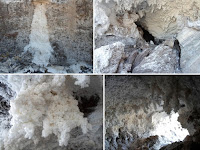
Salt Cave, Khoja Mumin Mountain, Vose District, Khatlon, Tajikistan
Chapter 8: In the Dread Murom Forest from Bear Metamorphoses

It was supposed to be a fishing trip, but it turned into a regular booze-up in the great outdoors, as often happens with men escaping the watchful eyes of their wives. One of my colleagues, who was from a local village near Kirov, had talked us all into going to a river aptly named Krivaya, or "Crooked." As Vysotsky sang: "In the reserved and dense, dreadful Murom forests, all sorts of unclean beings wander in hordes and sow fear in passersby."
How to Navigate by Weather Conditions on a Hike

Museum and Ancient City of Hulbuk, Vose, Khatlon, Tajikistan

Chapter 7: The Roads of the Pamirs from Bear Metamorphoses

After descending a bit lower, I found a cozy little clearing. It was warmer here. I decided to rest and figure out my route. I transformed, took out my phone to look at the maps, and saw—a missed call from Shams. I called him back immediately.
How to Navigate by the Sun on a Hike

All Ten Bridges in the Odjuk Gorge, Varzob, Mountains of Tajikistan

Chapter 6: The Curse of the Circle of Darkness from Bear Metamorphoses

Judging by the tracks, the Englishman, possessed by the jondor, after crossing the ridge, didn't descend but turned west. The altitude here, by the way, was considerable. A snow-covered section ran along the ridge's edge. After passing it, he turned. His path ran below the snow line but was still high up. Given how fast he was moving, one could only marvel at the Englishman's physical conditioning, whose name, incidentally, I still hadn't bothered to learn. If he continued like this without changing direction, he would eventually come out to a section of the highway between Ishkashim and Khorog. That road also ran along the border. Surely he wasn't going back to Afghanistan? That would be too much!
Celestial Navigation: How to Find Your Way by the Stars

Kumkayakutal Pass, 3-Day Hike, Semiganch Gorge, Romit, Mountains of Tajikistan

Popular Posts
-
 This time, I decided not to do a photo review like I usually do, for the simple reason that there are already more than enough photo review...
 -
 You can survive on cold rations, but a hot meal at the end of the day truly warms you up, restores your energy, and boosts your spirits. It...
 -
 I had known about this waterfall for a long time, but I never managed to see it. The thing is, the waterfall can only be seen in the spring...
 -
 Many beginners haunt their own imaginations with grisly scenes: hungry wolves lying in ambush or a bear specifically stalking a tourist aro...
 -
 Decided to take a walk to the hills behind Victory Park. Overall, the hike didn't go very well, I chose the wrong time, didn't equi...
 -
 Imagine the worst‑case scenario: you’re alone in the mountains. You get caught in a prolonged downpour, a mudslide sweeps down, or you simp...
 -
 ≪ to the previous chapter Surprisingly, Luka didn't show up right away. A couple of weeks later, I visited the snow people's settl...