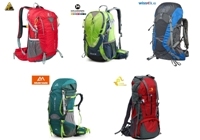
Usually, it’s pretty obvious, but it’s still helpful to talk about the different types of backpacks—just to broaden your horizons. Let’s start with the basic designs.
Backpack Designs
External Frame Packs
These use a rigid external frame. They were once popular, but today they are rare. Still, they have their place when you need to carry a lot of weight—large expeditions, rafting, caving—where bulky supplies or equipment are involved.
Internal Frame (Anatomical) Packs
Here the frame is inside and shaped to follow the contours of your back—hence the name “anatomical.” This is the most sought‑after design today. Variations include soft or rigid inserts, models for men and women, and packs with removable components.
Ventilated (External‑Frame Anatomical) Packs
These are essentially anatomical backpacks with a gap between the pack and your back for airflow. The frame is placed externally and separated by a mesh panel. This design makes it easier to remove components for drying or cleaning. The downsides are a slight weight increase and a shift in the center of gravity.
Lightweight, Frameless Packs
Once upon a time, all backpacks were frameless. Today, frameless construction is mostly found in small‑volume packs. When the load is light, you don’t have to worry about your back. The absence of a frame and extra features makes these packs light and compact—perfect for a day hike or a bike trip.
Now that we’ve covered the main designs, let’s move on to backpacks by volume and purpose. We’ll start with the smallest ones, often called “weekend” packs.
Weekend Hiking Backpacks
Volume: 20–50 liters..
Ideal for easy hikes, picnics, and short trips. Requirements are modest—a simple design will keep both the price and weight down. You can also use such a pack as an extra for side trips during a longer expedition. It’s a good choice if you don’t go hiking too often.
Climbing / Technical Packs
These are also 20–50 liter packs, but they come with advanced designs—anatomical or ventilated back systems. They belong to a separate category often called “technical” or “climbing” packs.
Key features:
• maximum comfort and durability;
• low weight and streamlined shape;
• high‑tech materials and construction.
They are used for ascents or short trips in harsh, extreme conditions where mechanical impact is likely. The streamlined shape and minimal pockets prevent the pack from snagging on rock edges or branches. There are usually attachment points for technical gear.
This category also includes rock‑climbing packs—lightweight, with gear loops, and designed to be unobtrusive on your back.
Then there are backcountry ski and freeride packs. Here the requirements are even higher:
• ski or snowboard carry system;
• compartments for goggles, avalanche probe, beacon, and shovel;
• a dedicated first‑aid kit pocket.
Many of these packs have certified back protection, and some are equipped with an avalanche airbag system (ABS). It works with a pyrotechnic cartridge and gives you a real chance of survival if you’re caught in an avalanche. Fully loaded with top‑brand features, such a pack can cost as much as a Boeing wing. By the way, the cartridges are not allowed on airplanes—something to keep in mind.
Trekking Packs
The most numerous category, thanks to its versatility. Manufacturers offer countless options in terms of volume, design, and materials.
Volume: 50 to 80 liters..
Trekking packs are suitable for most tasks—great for a wide range of hikers, trekkers, and beyond. If you don’t have highly specific requirements and need a pack that works for many situations, a trekking pack is exactly what you’re looking for.
Expedition Packs
Essentially, these are the same trekking or backpacking packs, but with a volume of over 80 liters. They are bought for expeditions, long self‑sufficient trips, river rafting, or mountaineering—basically whenever you need to haul a lot of gear to a base camp.
Next guide: Anatomy of Mountain Boots: From Hiking to Mountaineering Previous guide: How to Choose a Tent for Mountain Hiking: Criteria and Parameters You can view the full list here: Camping Life: Tips, Guides, Lifehacks


