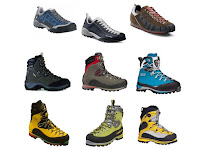
Here, I want to focus on the different types of footwear based on the difficulty of the route. Because without understanding these distinctions, it’s easy to get lost in the vast selection at the gear shop.
Let’s start with some basic terminology.
Types of Outdoor Activities
In the outdoor community, activities are typically divided into several categories. Knowing these terms will help you explain to a shop assistant exactly what you’re looking for.
• Hiking — day trips on marked trails, parks, nature reserves. The terrain is relatively easy, weather is usually favorable. You carry a daypack and walk for a few hours at most.
• Light Trekking — short trips lasting 1–2 days, often with an overnight stay. The terrain is more varied: ascents, descents, rocks, roots. Weather can change.
• Trekking — multi‑day trips (from 3–4 days) across diverse terrain, often with significant elevation changes. Your backpack is heavy, and weather conditions are unpredictable.
• Heavy Trekking — long‑duration trips in remote areas, often with elements of climbing. These require high physical fitness and specialized gear.
• Mountaineering — ascents and descents on challenging terrain (rock, ice) in low temperatures. This is no longer just a hike—it’s a technically demanding activity.
With these categories in mind, let’s look at footwear.
Footwear for Hiking
For day hikes on trails in dry weather, even good athletic shoes can work. But it’s better to choose trail running shoes—they have more aggressive tread than regular running shoes. If you step off the beaten path, you’ll appreciate the extra grip.
In rainy weather or on wet terrain, consider trail runners with a waterproof membrane or light trekking boots (more on those below).
Boots for Light Trekking
This is essentially the same as hiking, but on more rugged terrain. Add ascents and descents, and because the walk is longer, the weather becomes less predictable.
If you’re an experienced hiker with strong ankles, you might get away with hiking shoes. But for greater safety, look at light trekking boots. Why are they better?
• Higher cut means better ankle support and reduced risk of sprains.
• Keep out water, sand, dirt, and small stones.
• Protect against insect bites and snake strikes—unlike trail runners or sandals.
• Most modern models come with a waterproof membrane or water‑repellent treatment.
Trekking Boots
This is perhaps the most versatile footwear for hiking. Suitable for most tasks: from multi‑day treks to easy mountaineering (entry‑level). These boots aren’t as light as hiking shoes, nor as technically advanced as mountaineering boots. But their versatility makes them a great choice for a wide range of uses, and prices are still reasonable compared to specialized footwear.
Key features:
• The sole is stiff but more flexible than mountaineering boots. This lets you feel the ground better and reduces fatigue.
• Protect the ankle without restricting movement.
• Not designed for winter, but thanks to materials (leather, Cordura, nubuck) and the membrane, they retain heat reasonably well—fine for snow and light frost.
• Often compatible with snowshoes, touring skis, and flexible crampons (for non‑rigid boots).
Trekking boots are an ideal choice for beginners—a true “all‑rounder.” Later, as you gain experience and figure out what terrain you prefer, you can invest in more specialized footwear.
Heavy Trekking Boots
These are a transition between trekking boots and mountaineering boots. They’re chosen by mountain hikers whose routes combine long approaches with high‑altitude ascents, traversing passes, and frequent summit attempts.
Differences from trekking boots:
• Stiff, almost unbendable sole—essential for rock and ice work.
• Often have a rear welt for attaching semi‑automatic crampons.
• Thicker upper, designed for lower temperatures.
• Heavier than trekking boots, but lighter than full mountaineering boots.
The distinction from mountaineering boots is subtle but real: heavy trekking boots are still tolerable for long trail approaches, though less comfortable than dedicated trekking boots.
Mountaineering Boots
These are specialized boots for high‑altitude ascents, ice climbing, and technical rock routes. They are not suitable for regular hiking—too stiff, too heavy, too expensive, and require a breaking‑in period. But they deserve a mention so you understand the limits of other categories.
Key features:
• Multi‑layer soles, often reinforced with metal.
• Front and rear welts for attaching automatic crampons and skis.
• High rubber rand for protection against snow and moisture.
• Some models are double boots (inner and outer) for extreme cold.
• Complex lacing systems for precise fit.
All of this is relevant only for serious mountaineering—where, as they say, things get “real.”
The Membrane: Pros and Cons
Most modern outdoor footwear is equipped with a waterproof/breathable membrane (Gore‑Tex and similar). Manufacturers promise: your boots won’t get wet, but they’ll let moisture vapor escape—your feet will “breathe.”
The technology does work, but there are nuances that marketing often leaves out.
Pros of membrane boots:
• Protection from brief rain, morning dew, shallow puddles.
• Wind protection.
Cons:
• In prolonged rain, or if water enters from above (e.g., stepping into a stream), the boots will get wet anyway. The membrane doesn’t help when water pours in from the top or when hiking through bogs.
• Drying membrane boots on the trail is difficult—a campfire or stove will damage them, and air drying takes a long time.
• Membranes require maintenance: reapplying water‑repellent treatments, careful handling.
What to do if you’re heading into wetlands or expecting steady rain?
• Consider non‑membrane boots made of thick leather. They hold water for a while but dry faster.
• Use waterproof socks (with a membrane). These go over your regular socks and create a waterproof barrier inside the boot. Your feet stay dry even if the boots are soaked. Downsides: they’re expensive and require care.
Conclusion
Choosing mountain footwear is always a trade‑off between weight, stiffness, protection, and price. Understanding the types of trips and the corresponding boot categories will help you make an informed choice and avoid paying for features you don’t need.
Brief glossary:
• Welt — a raised ridge on the sole at the heel and/or toe for attaching crampons.
• Crampons — traction devices for walking on ice and hard snow. Types: strap‑on (flexible), semi‑automatic (attach at the heel welt), and automatic (attach at both heel and toe welts).
• Membrane — a thin, porous layer that allows water vapor to escape but blocks liquid water.
I hope this guide has helped you navigate the types of mountain footwear. Take care of your feet—and may your adventures be nothing but joy!
Next guide: Camping Light from a Phone and a Water Bottle Previous guide: Anatomy of a Hiking Backpack: Types, Designs, and Purpose
You can view the full list here: Camping Life: Tips, Guides, Lifehacks


