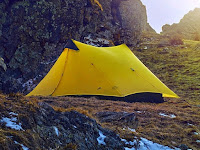
Anyway, if your life is somehow connected with hiking (or you live in a place where it’s easy to get out), it’s a good idea to think about getting your own tent in advance.
Criteria for Choosing a Tent for Mountain Hiking
The main criteria I use when looking at tents for mountain trips are price, weight, and versatility. First, it’s worth understanding that tents are designed for different purposes. The main types are:
• Camping tents – for car camping; heavy and spacious.
• Expedition tents – for long, demanding base camps.
• Mountaineering tents – for extreme altitudes and high winds.
• Trekking tents – for foot‑based mountain hikes, i.e., trekking.
Of course, if your route goes to serious altitudes where a mountaineering tent is required, this article probably isn’t for you—an accidental hiker doesn’t end up there. That said, good mountaineering tents can be considered the most versatile: they are relatively comfortable, handle any weather, are light, and quick to set up. But the price is often sky‑high.
Price of a Tent for Mountain Hiking
A trekking tent isn’t something you need in everyday life—unlike, say, a backpack or a sleeping pad.
For example, I sometimes go to the market with a large backpack. At first I felt awkward, but after a couple of trips I got used to it: it’s convenient and I can carry a lot in one go. My sleeping pad is always in use because I also use it for yoga—I bought it with that in mind.
I’ve digressed. But you can’t really use a tent for anything else, and if you don’t go on trips often, it just sits there gathering dust. So whether to spend a significant amount on a tent is a question everyone answers for themselves.
Weight of a Tent for Mountain Hiking
This one is obvious. If it’s a multi‑day trek, especially in the mountains, the lighter the tent, the better.
Here this point overlaps with the previous one: the lighter the tent, the more expensive it is, because manufacturers use higher‑end materials.
Versatility of a Tent for Mountain Hiking
This is the most extensive section, covering several important sub‑points.
1. Capacity
I consider a two‑person tent the most optimal and versatile—even if you hike alone.
More spacious tents are good for specific purposes: camping, expeditions, etc.—they aren’t versatile. One‑person tents are usually expensive, weigh almost as much as a two‑person tent, and aren’t always comfortable. A two‑person tent is a different story. What if you go with someone? And even alone, it’s roomier: you can wait out bad weather and keep your gear inside if the vestibule is small or nonexistent.
2. Seasonality
There are summer, three‑season, and winter (expedition) tents.
• Summer tents – cheaper and lighter, but designed for warm, sunny weather. Not suitable for multi‑day or mountain trips.
• Winter tents – use more waterproof materials, a stronger frame (to handle snowfall), and often have a stove jack. They are noticeably heavier and more expensive.
These two types don’t fit the versatility criterion. That leaves three‑season tents—the sweet spot for most mountain routes.
3. Tent Construction
Trekking tents come in A‑frame (ridge), tunnel, and dome styles.
• A‑frame – an older design. Not very wind‑stable and somewhat awkward to pitch.
• Tunnel – easier to pitch than A‑frames, but still require extra guy lines and are less stable in side winds.
• Dome – the most versatile option. These tents are more reliable in windy conditions and can be set up even without stakes. I once had a situation on a rocky slope: nowhere to put stakes, and no rocks to weigh it down—yet we made it through the night just fine. The only drawback of a dome is that it’s slightly lower than an A‑frame, but that’s not a big deal.
4. Tent Type
Single‑wall or double‑wall? This comes down to personal preference.
• Single‑wall – lighter and simpler to pitch. Downside: condensation collects on the walls, and you need to dry it before packing.
• Double‑wall – heavier and a bit more complicated to set up, but more comfortable: condensation forms on the inner tent and doesn’t drip onto your sleeping bag.
I personally prefer single‑wall and never had any major issues. But this is something everyone chooses for themselves.
Technical Specifications
1. Waterproofing
The average waterproof rating for a trekking tent is 2000 to 3000 mm water column.
• Below 2000 mm – a summer tent, designed at most for a light shower.
• Above 3000–5000 mm – will handle a prolonged downpour.
Important: exceeding what you actually need affects price and weight. But if you often hike in rainy regions (like the Caucasus or Altai), it’s better to look for ratings around 4000 mm for the floor and 3000 mm for the fly.
2. Materials and Features
What fabric is used, the weave, taped seams, floor material, pole construction… I solve this one by simply choosing a reputable brand. With a reliable manufacturer, everything is already designed and built as it should be, so you don’t have to memorize a bunch of technical details.
Also pay attention to:
• Ventilation (vents to reduce condensation);
• Number of doors and vestibules;
• Small touches: pockets, loops for a lantern;
• Mosquito netting on doors and vents;
• Zipper type (plastic is preferable—it doesn’t snag or damage the fabric).
These aren’t critical but rather personal preferences.
Where to Buy
There are many manufacturers today, and the number of tent models is huge. Even in a large store you can’t always find the right one. The answer is online stores. At home, you can calmly compare options, study the specs, read reviews—without the rush of a retail floor.
Next guide: Anatomy of a Hiking Backpack: Types, Designs, and Purpose Previous guide: ---
You can view the full list here: Camping Life: Tips, Guides, Lifehacks


