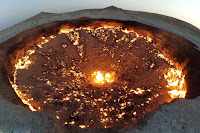
Turkmen call it Jähenneme açylan gapy, while the English version is “The Door to Hell.” Some even call the Darvaza gas crater a wonder of the world. Yet the appearance of this “wonder” was quite prosaic.
It must be said that for a gateway to the underworld, the location is perfect. The crater lies in the very heart of the “black sands”—that is what the local desert, Karakum, means. From Ashgabat, the capital of Turkmenistan, the crater is about three hundred kilometres away. The nearest settlement, the village of Yerbent, is roughly a hundred kilometres from it.
The crater is situated somewhere along the Ashgabat–Kunya-Urgench highway. From the highway, you need to drive another five kilometres along a dirt road, some sections of which are completely covered with sand. It is best to visit the crater in a 4×4 vehicle.

The former village of Darvaza was officially abolished in 2004. But local residents who once lived there still gather here. I suppose it is all because of tourists: they probably offer some small services, and they also sell roadside coffee near the crater. In short, it provides some kind of income. Around it is a virtually lifeless desert, yet everyone needs to make a living.

These “Gates of Hell” formed in 1971. At that time, geologists suspected a large accumulation of natural gas in the area and began exploratory drilling. During the drilling, they discovered a huge underground cavern filled with gas. But in the process, the cavern collapsed, burying the rig, all the equipment and vehicles. Only by sheer luck did no one get hurt.

Because of the massive gas leak, it was impossible to continue working or retrieve the equipment. So someone came up with a “brilliant” idea—to set the gas on fire. The plan was simple: it would burn out in a couple of days, and then they could resume work. But the gas is still burning today. By the most modest estimates, several billion cubic metres of natural gas have already been consumed by the flames.


Be that as it may, today it is a tourist attraction—one that still exists. There is a chance that the crater will eventually be extinguished, or that it will burn out on its own someday. The president of Turkmenistan decided to put it out after visiting the crater in 2011. He ordered a special programme to study the crater and the possibility of extinguishing it. But to this day, no sufficiently reliable method has been found.
And so the Darvaza gas crater continues to burn, much to the delight of tourists. And there is plenty to see: the crater is sixty metres in diameter, about twenty metres deep, and the flames sometimes reach ten to fifteen metres high.

In 2013, Canadian explorer and adventurer George Kourounis descended to the bottom of the crater. The goal of his expedition was to collect soil samples from the bottom of this fiery well. Scientists wanted to determine whether any organisms could survive in such conditions.
Kourounis not only took samples but also discovered unique bacteria that do not live on the Earth’s surface. These microorganisms thrive only in specific environments—for example, at the bottom of a scorching crater. Upon his return, the researcher called the “Gates of Hell” the Colosseum of Fire: thousands of small flames burn all around, and, surprisingly, there is no smoke to be seen. The only sound is a powerful roar, reminiscent of a jet engine.

Not far from the burning Darvaza crater, there are several almost identical sinkholes. Their main difference is that they do not burn. At the bottom of one of these craters is a light‑grey mud that constantly bubbles from the gas seeping up to the surface. Another crater is filled with turquoise water.
It is not recommended to get too close to these craters: the sand around them is very loose and could collapse at any moment. They are fenced off, and almost no one goes near them.


Tourists here can be quite exotic. Take, for example, this ninja—a Japanese Twitter user who dresses in a ninja costume at various locations and posts photos on social media.


Here are more pictures of the burning gas crater at Darvaza,
taken at different times of day and with various visual effects.


