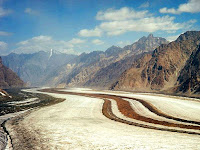
This massive river of ice stretches for 77 kilometers. The glacier is in constant motion, "flowing" at a rate of approximately 70 centimeters per day. Interestingly, the ice moves faster in its upper reaches and slows down significantly as it descends.

Geography and Scale
At an altitude of 2,900 meters in the Balandkiik Valley, the glacier begins to melt, giving birth to the Sel-Dara River. The water literally bursts forth from beneath the towering wall of ice.
The Fedchenko Glacier is classified as a complex mountain-valley glacier. In its class, it is the absolute global leader in length and ranks among the top three largest by volume. Including the entire glaciated area and surrounding snowfields, its volume is estimated at approximately 93–94 cubic kilometers. The width of the ice field ranges from 1.5 to 3 kilometers, and the thickness of the ice reaches up to one kilometer in certain sections.

History of Discovery: Oshanin and Fedchenko
The glacier was officially discovered in 1878 by an expedition led by Vasily Oshanin. It was Oshanin who named the glacier after Alexei Fedchenko. That year, only the lower part of the icy giant was explored. It took another fifty years for researchers to reach the upper reaches, a feat accomplished in 1928 by the Tajik-Pamir Expedition of the USSR Academy of Sciences.
There is a common misconception that Alexei Fedchenko discovered the glacier himself. In reality, his expedition only saw it from a distance while drafting a general map of the Pamir ranges. At that time, Fedchenko’s team was primarily focused on studying the Zaalay Range.

A Legendary Figure
Who was Alexei Pavlovich Fedchenko? He was an outstanding Russian scientist, traveler, and geographer. A truly legendary figure, in his short 29 years of life, he left behind a colossal legacy in the fields of geography, botany, and entomology.
Fedchenko spent three years in Turkestan, exploring regions within modern-day Tajikistan. His final expedition year — 1871 — was dedicated to the Pamirs. Circumstances forced him to cut his research short and return to Moscow, where he spent two years systematizing his findings and presenting reports on his discoveries.

Tragedy in the Alps
Fedchenko dreamed of returning to Turkestan to continue his study of the "Roof of the World," which in those years remained a "terra incognita" for European science. Even the circumstances of his untimely death in 1873 were tied to this dream.
Alexei Pavlovich died on the Col du Géant glacier at the foot of Mont Blanc in the Alps. He had traveled there to gain experience in high-altitude mountaineering, believing it would better prepare him for his future expeditions in the Pamirs.
Fate, however, had other plans. During the ascent, the weather turned violent. The guides accompanying him proved inexperienced; they abandoned the exhausted scientist and descended to seek help. By the time rescuers returned, Fedchenko had passed away. His wife later maintained that Alexei was still alive when he was found and that he could have been saved if a doctor had been part of the rescue party.
Alexei Fedchenko is buried in Chamonix, at the foot of Mont Blanc. A memorial plaque on his granite monument bears a prophetic inscription:
"You sleep, but your works will not be forgotten..."


