
It later turned out that the mountain is indeed called Olam Jakhon, but why, I couldn't find out. No matter who I asked, everyone said that's what this mountain has always been called, since ancient times. Mount Olam Jakhon is located on the watershed ridge between the Varzob and Romit gorges. Several tributaries of the Kafirnigan and Varzob rivers begin their descent from the slopes of this mountain. The Yos and Semiganch rivers flow into Romit. On the Varzob side, these are the Ojuk River and the tributaries of the Takob River - Churakdara, Shurasoy. In general, it's more of a mountain massif with a chain of peaks and a high-mountain plateau between them, rather than just one mountain. The plateau area is about a couple of square kilometers. The height of the lowest peak is 3400 meters, and the highest is 3453 meters. On all maps, these peaks are unnamed, and the mountain massif itself is not marked in any way.
The name "Olam Jakhon" is mainly used by locals. Mount Olam Jakhon rises above all surrounding areas; the visibility from the mountain is 15 kilometers, and it's not only far but also very beautiful. The Yos, Semiganch, and Ojuk gorges are clearly visible; parts of the Takob and Alkhun gorges can be seen. The city of Vahdat is clearly visible, and Dushanbe city is visible, though not very well. There are no trees on the mountain at all, but there are many streams. I was on Mount Olam Jakhon at the end of July, and there was still snow in some places.
Many routes lead to the mountain, but practically, only a few of these paths are suitable for free passage. Two of them go from the plateau that lies between the Kichkine and Childukhtaron passes. One is gentler, the one I ascended; this is a spur on the northwestern side between the Churakdara stream and the road leading to Safed-dara. I descended via another, steeper spur located on the southwestern side leading directly to the Kichkine pass. There also seems to be a gentle slope from the north, but I couldn't examine it because there was a herd on the northern slope with dogs nearby, and I didn't go there.
I decided to go to Mount Olam Jakhon via the Odjuk Gorge. First, I needed to ascend to the plateau between the Kichkine and Childukhtaron passes. Earlier, when I was hiking the Odjuk Ring route, I saw in one place that besides the passes, there was some other trail leading to the plateau, and I decided, if possible, to ascend to the plateau via that trail. At one of the forks in the Odjuk Gorge, I struck up a conversation with a local shepherd and found out from him how to ascend via that trail between the passes. It turned out this trail starts in the gorge where I had once been on a hike to the Childukhtaron pass. Back then, we turned left from this gorge to ascend the spur leading to the pass. But to get on the trail leading to the plateau, you need to turn right. Using the landmarks he suggested, I found the turn-off point and climbed the trail a little way. Since it was already around four o'clock, I decided not to go further that day. I found a convenient spot for a camp and stopped for rest and an overnight stay. In the morning, with renewed energy, I began the ascent to the plateau.
Here I turned off the main direction of the Odjuk Gorge into a side gorge. Photo just showing where I headed.

A couple of photos of this side branch of the Odjuk Gorge.


I reached the turn; further on, the end of this gorge is already visible. Honestly, when I found the spot for my camp and left my things there, I came back here and even walked to the end of this gorge, just out of interest, since time allowed. I took photos there too, of course, but they turned out somehow indistinct.

From this branch, I turned here.

Having found a place to camp, I spent the night, rested well, and with renewed energy, continued along the trail.

The trail first goes through a narrow rocky canyon.


I climbed a bit, and my overnight spot became visible from above.

Interesting things along the way: I came across several caves, but all were inaccessible for examination, maybe another time.


I ascended the spur.

Here I encountered an interesting place. The photo shows a group of trees. So, while down below I only came across wolf and fox tracks, here there were bear tracks everywhere. Considering how remote this area is, it seems like this is some kind of bear's den, and judging by the tracks and droppings, a rather large one.

It was right from this bear corner that I went sideways.


Because it's impossible to get through upwards here. Theoretically, of course, you could, but practically it would be a real strain; better to go around.

Came across an interesting juniper, growing upside down, that is, with its roots at the top.

Meanwhile, I moved to the next spur, and from it, I could already see the spur where the trail leads onto the plateau.


Here I am on that spur now.


And here, actually, is the trail.


A little higher up, one of the peaks located on the edge of the plateau becomes clearly visible. I climbed this one during the Odjuk Ring route hike.

The saddle appeared, meaning the trail's exit onto the plateau.

This is what the trail looks like from here.

Finally, the exit from the trail onto the plateau, and immediately the goal of my hike becomes visible - Mount Olam Jakhon.

Now I can survey the slope I climbed to get to this plateau.


True, I still need to reach the plateau, but it's not far at all, so it doesn't count.

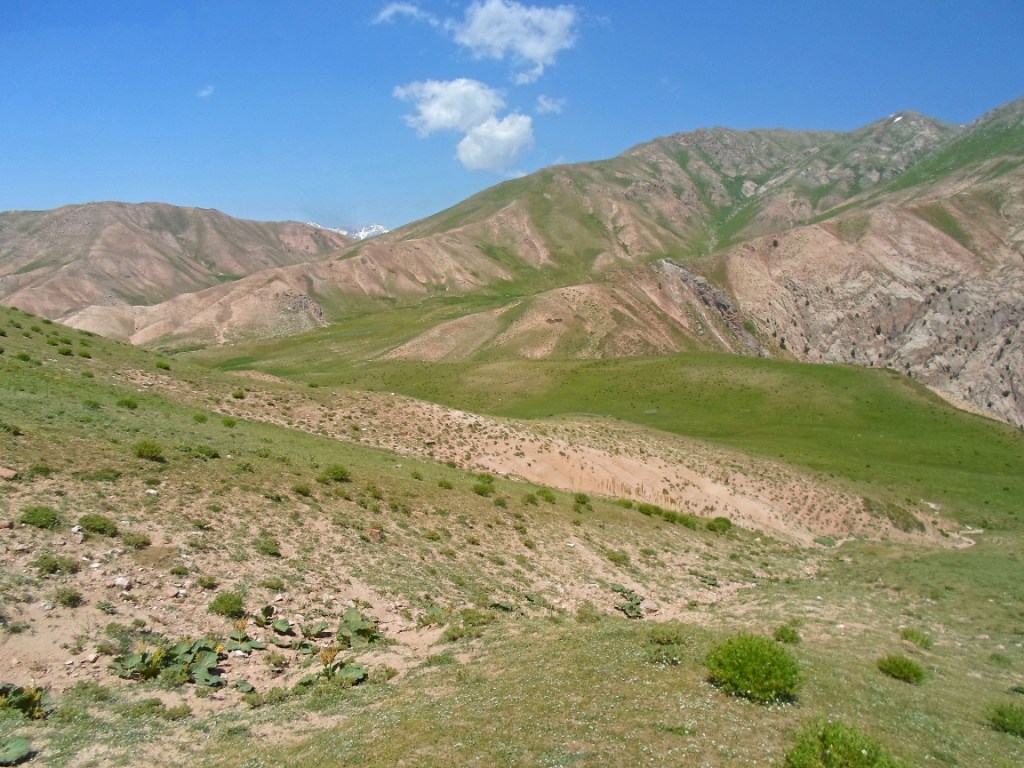
And here, Mount Olam Jakhon appears before us in all its glory, as they say.

On the plateau itself, nothing particularly remarkable, except perhaps "foxtails" (a type of grass/plant).

From here, the two paths to Mount Olam Jakhon, which I wrote about at the beginning, are clearly visible. I ascended via the left spur and descended via the right one.

So, I climbed onto this left spur; here the trail leading to Safed-dara is clearly visible.

Here you can see where I came from across the plateau. The Churakdara stream flows across the plateau; it's a tributary of the Takob River, which in turn is a tributary of the Varzob River.

Now, only upwards.

During the ascent, I encountered another large clearing with foxtails.


After that, everything is, in general, prosaic. I slowly ascend, encountering rocky outcrops closer to the end of the climb, and enjoying the views from this slope.


Well, I can say I've made it up. And photos in a circle from this corner, now from the plateau on Mount Olam Jakhon.


As I wrote above, there was a herd on the northern slope, so I didn't go towards that edge. Instead, I immediately headed towards this peak; here the slope is not steep, and walking became easier.

Photos in a circle from the path to this elevation. In the first photos, the Romit side becomes visible.


I climbed the peak; if I'm not mistaken, this is exactly the one marked on maps as a peak with a height of 3400 meters. I took panoramic photos from this peak. It was time to settle down for the night, and I decided to camp right on this peak. The large boulders here provided good protection from the wind, which at this altitude had become noticeably cool. And when the sun set, it became downright cold, not freezing of course, but still... But behind the boulders, with a small fire, the evening was just wonderful.


Dawn the next morning. A photo, of course, can't convey how it actually looked. But the dawn was truly wonderful, or maybe it just seemed that way to me. I'll still add a couple of photos of this dawn on Mount Olam Jakhon.


And my path lies further along the peaks that tower over the plateau on Mount Olam Jakhon.

I descended from the peak where I spent the night, and here's a photo of it from the other side.

I climbed the next peak, which had been looming before me since yesterday. Photos from it in a circle.


Photos from the next peak. It's located at the very corner; from here the gorge of the Yos River on the Romit side is clearly visible. Right down there is where the Yos River begins.


I went to the next peak; here it is up close.

Now, photos in a circle from this peak. By the way, from here, the highest peak of Mount Olam Jakhon becomes visible; it's one more peak away.


Photos from this intermediate peak, looking back and forward.


And here is the highest peak of Mount Olam Jakhon, its height is 3453 meters.

Photos in a circle from this highest peak, starting from the direction I came from.


Photo of this highest peak from the other side.

The next peak will be the farthest one on the southeast side of Mount Olam Jakhon. From it, also photos in a circle, starting from where I came. From this peak, the gorge of the Semiganch River, where I also hiked during this trip, is clearly visible.


Right next to this peak is another one; the photos from it are the same as from the previous one, so I'll only add a few.


From the peak, I went through the center of the plateau to the next elevation on the southern side. Photos from the center of the plateau.


Photos in a circle from this elevation on the southern side of the plateau.


I crossed the center of the plateau again and finally reached the far southwestern peak. From here, I will descend. The Ojuk Gorge and the spur I used to ascend Mount Olam Jakhon are now clearly visible.


And here is the spur I plan to descend.

And this is the now-familiar plateau between the Kichkine and Childukhtaron passes.

I need to descend here, to the Odjuk Gorge.

I didn't take photos during the descent; basically, I had already captured everything. In the photo is the spur I just descended.

This spur leads right onto the saddle of the Kichkine pass.

Here I am at the Kichkine pass. From this point, my route completely merges with the Odjuk Ring route, so there's no point in taking photos again. The only difference is that last time I was ascending this path, and now I'm descending, but that doesn't really matter for photos. Following the Odjuk, I reached the village of Varzob and returned to Dushanbe.

All the Best to You and Interesting Hikes!


