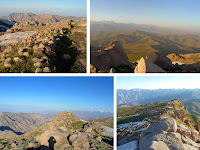
During a hike to Mount Olam Jahon, after I had climbed onto the plateau at its summit, I noticed a few oddities — both of the plateau itself and of the peaks situated on it. It is these oddities, and the conclusions I drew while examining them, that I wish to share in this short article.
The first thing that caught my eye was that the peaks are found only along the edges of the plateau and, moreover, are roughly equidistant from one another. Of course, this could be mere coincidence, but such coincidences are exceedingly rare in nature. This led me to wonder whether some of these elevations might be of artificial origin.


Later, while circling these elevations to find good angles for photographs, I noticed clusters of stones that closely resembled masonry. This only reinforced my initial conclusions.


Inside these presumed walls, there were piles of stones that looked even more like ruined buildings.


It seems to me that an ancient fortress once stood here, now almost completely destroyed. The peaks along the edges of the plateau strongly resemble watchtowers: over time they crumbled and turned into the elevations that are now considered the peaks of Mount Olam Jahon.


It seems to me that an ancient fortress once stood here, now almost completely destroyed. The peaks along the edges of the plateau strongly resemble watchtowers: over time they crumbled and turned into the elevations that are now considered the peaks of Mount Olam Jahon.


At first, while pondering all this, I doubted whether placing a fortress in this particular spot had any practical sense. However, after surveying the entire mountain and the plateau, I realized: while such a fortress might not be very comfortable for year-round living, it would be extremely suitable as a watchtower stronghold or as a refuge when large enemy forces approached.


Firstly, surrounding it would have been practically impossible. Yes, the ravines leading to the fortress could be blocked, but only if one knew them. There are many such ravines, and each would require a large detachment to reliably prevent a breakthrough — an endeavour demanding a huge number of people.


Secondly, the defenders would have had little need to break out anywhere. There is water on the mountain — not from melting snow, but genuine spring water, welling up right at the top. Additionally, there are two large plateaus here: one at the summit of Olam Jahon, and another slightly lower, right in front of the mountain, which is also easy to defend since only a few paths lead to it. If livestock were brought to the plateau, they would have enough to graze on, which means there would be food for the people as well. Thus the defenders would be supplied with everything necessary while remaining safe. Moreover, the size of the fortress could accommodate quite a large number of people.


Thirdly, defending the fortress would have been very easy. Only a few relatively gentle paths lead to the summit plateau, and all of them can be easily controlled. Visibility from the mountain in all directions, according to the map, reaches up to 15 kilometres, making a stealthy approach simply impossible. Strategically, the location is ideal for a fortress.


I am no expert, so I cannot judge whether any historical sources mention a fortress in this place. Judging by the fact that the locals know nothing about it, if a fortress ever existed, it was a very long time ago. To answer all these questions, full-scale research and archaeological excavations are, of course, needed. If that happens, it is quite possible that yet unknown historical data about this area and the people who lived here in those times will come to light.
You can explore Mount Olam Jahon in more detail here: Hike to Mount Olam Jahon..


